Posts

Showing posts with the label shrub

Heavy-duty plant-shopping → trunk full of plants

Image
On Saturday, I made the 50-minute drive to Walnut Creek to attend two morning events at the Ruth Bancroft Garden . The first was a 7:30 am sunrise photography session followed by a 10:00 am class on proteaceae (shrubs like grevilleas, banksias, leucospermums, leucadendrons, etc.) where, among other things, I got to demonstrate how to plant a groundcover banskia and I learned that I wasn't adding enough sulphur to our alkaline soil to make it more acidic. (And that coffee grounds as a mulch are good because they attract earthworms.) I'll have a separate post with my best images from the sunrise photography session. Today I want to show you my plant haul. I still can't believe I came home with as many new plants as I did. Serendipity or insanity? Something it's a fine line!

Update on Jacaranda 'Bonsai Blue'

Image
Two years ago, in June 2015, I bought a dwarf jacaranda sold by Monrovia under the name 'Bonsai Blue' and I planted it in large concrete container on our back patio. Click here to read my original post. A lot of people have asked me how that jacaranda has fared. Time for an update! 'Bonsai Blue' is very much alive. In fact, it's blooming for the first time ever! I'm very excited because I wasn't sure it was ever going to flower, seeing how it receives only a few hours of direct sun. In full sun, I imagine it would be covered with flowers, just like a regular full-size Jacaranda mimosifolia .

Butchart Gardens on the cusp of spring

Image
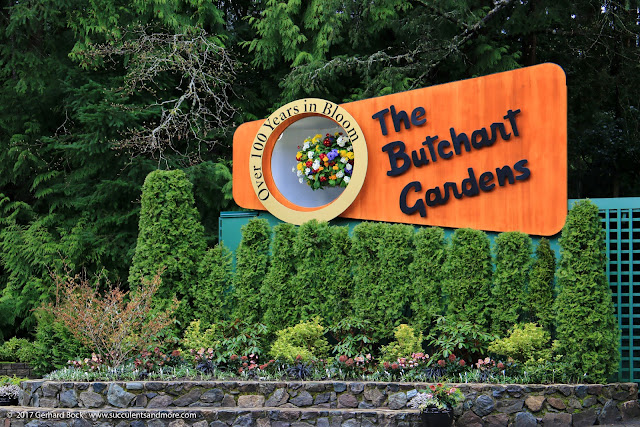
At the end of March, the Butchart Gardens , arguably North America's most popular public garden, should be a sea of flowering bulbs. Not so this year. "There has never been a year where we have so eagerly anticipated the arrival of spring in our garden," Rick Los, Director of Horticulture at the Butchart Gardens, writes in the Spring 2017 Garden Notebook : With all the talk of global warming we were expecting and planning for another early spring, but in a humbling change of events, Mother Nature decided to cool our region off significantly during the past few months. That being what it was, the garden itself did not suffer any unexpected physical damage. However, in comparison to last year, our floral calendar is almost a full month behind. Reading this was no surprise. That's pretty much the case across the Greater Victoria area and across the entire Pacific Northwest. I debated whether I even bother to go to the Butchart Gardens but then curiosity won out. I w...

A little grevillea action to brighten your pre-Thanksgiving weekend

Image
I love fall in Davis. The days are still warm, and many plants come into their own again after slowing down in the summer. Case in point: grevilleas. These Australian shrubs, members of the Proteaceae family , are right at home in California’s Mediterranean climate. As is the case with so many plants (and people!), they’re at their happiest on the coast, but we can grow quite a few of them here in the Sacramento Valley, about 60 miles inland from San Francisco Bay. In fact, the UC Davis Arboretum has a nice collection of Australian natives that thrive here. Today I want to show you two grevilleas in our own garden that are flowering right now. Grevillea ‘Superb’ Grevillea ‘Superb’ has been with us for 4 1/2 years. I bought it in February 2012 at the UC Santa Cruz Arboretum and first planted it in the backyard. Unfortunately it didn’t receive enough sun there so I moved it into the front yard circa 2014. I’m sure it lost a good chunk of its roots in the process—grevilleas don’t li...

Meanwhile, on the homefront…

Image
From my recent posts, sparse as they have been, you might have gotten the impression that I haven’t been home much. Actually, I have been, but work has been unexpectedly busy, exacerbated by the forced absence of my business partner who has had to take PTO to be with an ailing parent overseas. Gardening has been sporadic, but I have been taking photos. I’ve even started on a couple of projects in the backyard, relegated to also-ran status in recent years. All that is about to change, as you will see in a separate post later this week. For now, let’s take a look at the front yard, specifically what used to be the front lawn . This is what you see as you approach from the driveway (literally steps behind the spot from which I took this photo). I don’t think I’ll ever get tired of this view. It’s everything I had hoped for.

Nothing but California natives: Josh Williams’s garden

Image
The third and final private garden we visited as part of Pacific Horticulture Society’s Summit 2016 belongs to Josh Williams, the manager of California Flora Nursery . According to the description in the Summit 2016 driving tour: [he ] converted the flat lawns and bare soils of his urban garden into a landscape dedicated to the striking diversity of plants native to California, particularly those of Sonoma County. You’ll find the half-acre parcel divided into ecological zones displaying distinct plant communities as they’re found in nature. I’m not an expert on California natives, and even after reading The Drought-Defying Garden: 230 Native Plants for a Lush, Low-Water Landscape by Greg Rubin and Lucy Warren I wouldn’t know how to begin creating an all-native garden. In addition, I’ve seen some insipid examples over the years that have left me anything but inspired. All this was going through my head as we we were driving from Mary and Lew Reid’s hilltop Eden in rural Sonoma Cou...

Botanical paradise with a view: Mary and Lew Reid garden

Image
This post continues the tour of the private gardens in Sonoma County, California I had the privilege of visiting as part of Pacific Horticulture Society’s Summit 2016 . The first garden we saw was garden designer Roger Raiche’s place in Guerneville. Stop #2 was Mary and Lew Reid’s garden outside of Sebastopol. This is how it was described in the 2016 Summit program: Mary and Lew Reid’s garden is 25 years old and ever changing. Lew, who never passes up a chance to grow a plant, and Mary, a landscape designer, have the pure pleasure of creating this beautiful garden painting high above Sonoma County’s lowlands, The zone 8 setting makes it possible to grow just about anything, and their garden is filled with plants from all over the world. What matters most to them is the juxtaposition of foliage colors and textures. Carefully considered, these carry the garden throughout the year. You’ll see it in its autumn glory. It took quite a while to get there from the first garden. The roads we...

Perfect flower on Leucospermum ‘Goldie’

Image
It’s no secret that I love the Proteaceae family. Most of these Southern Hemisphere shrubs—think of the sugarbushes (proteas), conebushes (leucadendrons) and pincushions (leucospermus) from South Africa, or grevilleas and banksias from Australia, to name just a few—have beautiful foliage, stunning flowers or both. The pincushions (leucospermums) aren’t all that blessed in the leaf department, but they more than make up for it with their stunning inflorescences. Just take a look at some of the images on Google to see what I mean! Unfortunately, leucospermums have proven challenging to grow here in Davis. Unlike leucadendrons, grevilleas and banksias, with which I’ve had good luck, leucospermums seem to be more sensitive to the summer heat and winter cold (even in a mild-winter climate like ours). My beloved Leucospermum ‘Scarlet Ribbon’ died a sudden death last summer, probably because the spot it was in was too hot. Leucospermum cuneiforme ‘Goldie’ flower on April 21, 2016 But ...

‘Bonsai Blue’ jacaranda, where have you been all my life?

Image
I’ve made no secret of my love for the blue jacaranda ( Jacaranda mimosifolia ). This South American native may be a messy tree— really messy, not politely so like our ‘Desert Museum’ palo verde —but few trees can hold a candle to it for sheer beauty when in bloom. And even when it isn’t, its fern-like foliage is attractive year round. Quite a few cities in warmer climates turn a sea of blue when Jacaranda mimosifolia blooms in the late spring. This includes Pretoria , South Africa; Sydney , Australia; as well as Los Angeles and other places in Southern California. Even here in Davis we have a few jacarandas although my favorite tree on 8th Street was cut down last year (no idea why; it was the only thing pretty at an unattractive older apartment complex). When we removed the truly messy (there’s that word again!) ornamental purple plum next to the driveway in September 2013, I briefly toyed with the idea of planting a Jacaranda mimosifolia but ultimately decided in favor a ‘De...

Quarryhill Botanical Garden

Image
I’ve been to most botanical gardens in Northern California but one had eluded me until this week: Quarryhill Botanical Garden. It is located outside the small town of Glen Ellen , best known as the home of writer Jack London (he lived there on a 1,000 acre ranch until his death in 1916). While less than an hour and a half from my house, Quarryhill is tucked away in rural Sonoma County where I rarely go. Not sure why, it’s beautiful there. I almost missed the entrance, tucked away as it is between cabernet sauvignon vineyards I knew that Quarryhill is world-renowned for its collection of Asian plants, many of them endangered in their native habitats. What I didn’t know is that the garden is only 27 years old. It’s the brainchild of restaurant heiress Jane Davenport Jansen who donated the site (25 acres) and financed 15 plant collection expeditions to Asia until her untimely death in 2000 at the age of 60. Read this very interesting article from Pacific Horticulture Magazine for mor...

Cousin Itt moves in

Image
Yesterday started out on a sad note as I removed yet another potted bamboo. This Sinobambusa tootsik ‘Albovariegata’ had been growing for years in a large bowl (29” wide by 14” tall) next to the family room slider. With its beautifully variegated leaves it was one of my favorite bamboos. Unfortunately, I had never been completely happy, most likely because of our high heat and low humidity. This year, at the peak of the drought, I simply hadn’t watered it enough and it had been in a tailspin for months. I finally decided to put it out of its misery. This freed up a prime spot in our backyard…

Camellia and daphne and … agave?

Image
Once upon a time, water seemed plentiful in our corner of California, I planted bamboos wherever I could, and this blog was known as Bamboo and More. In those halcyon days, the Borinda papyrifera in our backyard was lush and green because it was getting enough water (mostly thanks to thrice-weekly irrigation). October 23, 2012 Fast forward to 2014. California is in the iron grip of a multi-year (permanent?) drought. I’ve cut back our irrigation schedule to once a week. Most Mediterranean-type perennials and succulents aren’t fazed, but many of the bamboos are suffering, especially the ones in pots but also Borinda papyrifera . February 25, 2014 Earlier this year it became clear that this bamboo wasn’t going to look good enough on less water. The new shoots were smaller in diameter than last year’s, which would lead to even more flopping and an even more disheveled look. After much back and forth, I finally made the difficult decision to take it out. The actual removal took place ...

Camellias in Sacramento

Image
The Sacramento Camellia Show is the largest and oldest of its kind in the country. This past weekend marked the 90th anniversary of the show. I checked it out on Sunday with a friend who loves camellias. Personally, I don’t know much about them but I enjoyed looking at the flowers—and I was surprised by how many different types and varieties there are! I can’t tell you much about what you’ll see in the photos below, but I thought those of you living in colder climates might be cheered by the pretty flowers. The Sacramento Memorial Auditorium was filled with thousands of camellia flowers A few dozen chosen entries were displayed on round tables…

What I saw on the way to the Wave Garden

Image
When we visited the Wave Garden in Point Richmond on Presidents Day, we ended up parking a few blocks away because we didn’t know where entrance was (it’s at the end of Grandview Court). I enjoyed the short walk because we saw quite a few interesting sights on the way. Point Richmond is right on San Francisco Bay and hence virtually never experiences frost. Their zone 10 climate is ideal for tender succulents like Agave attenuata and Crassula ovata . Here in Davis, just an hour away (zone 9b), they would struggle to survive outside during the winter even though our winters are anything but harsh. Foxtail agave ( Agave attenuata)

Daphne for Valentine’s Day

Image
Instead of cut flowers, this is what I gave my wife for Valentine’s Day: Daphne odora ‘Maejima’ A wonderfully fragrant daphne with particularly striking variegation. This relatively recent introduction is called ‘Maejima’. The cream-colored leaf margins are wider than in the more common Daphne odora ‘Aureomarginata’, and it supposedly is a bit easier to grow as well.