Posts

Showing posts with the label mealybugs

Guest post: Mealybugs, spider mites and scale — oh my!

Image
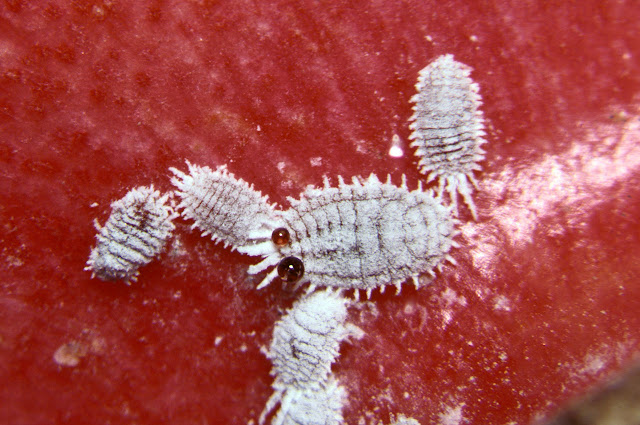
Mealybugs are one of the biggest headaches in my garden. It seems that no matter what I do, they always come back — or never really go away in the first place.  After reading my post from early November ( here ), long-time follower Ray Handyside from Fairfield, CA told me about a home-made treatment he’s been using successfully in his garden. I thought this might be of interest to other gardeners out there who fight the same battle and asked Ray to write a guest post sharing his experience. Thank you, Ray, for taking the time to do this. Mealybugs, Spider Mites and Scale — Oh My ! by Ray Handyside As most garden enthusiasts can attest, putting in a nice garden is a lot of work. If that garden has a succulent focus, it seems the actual “installation” is an ongoing task because that work includes making updates, adding plants (cram-scaping) and replacing bloomed-out specimens (like agave, aeoniums, etc.). Mealybugs on a flower (Lantana sp.) stem. By Crisco 1492 - Own work, CC BY-SA 4...
Mealybugs revisited: still one of my biggest headaches in the garden

Image
As much as gardeners love to talk about plants, they love to talk about bugs just as much. At the top of the list of the most common and most annoying pests are mealybugs. Virtually every gardener I talk with is embroiled in a neverending and seemingly futile battle with the fuzzy buggers. I’ve written about mealybugs before ( as early as 2011 !), but it’s a topic that’s worth revisiting. Mealybugs are tiny unarmored scale insects found in warm, dry habitats. What we typically see are the females. They’re covered with a protective white, waxy, or cottony powder. Most retain their legs and can move slowly. In contrast, the males are winged, look like fluffy gnats, and live only briefly to fertilize females. Citrophilus mealybug ( Pseudococcus calceolariae ), one many mealybug species Q. Holdman, Public domain, via Wikimedia Commons Mealybugs use needle-like mouthparts to pierce plant tissue and suck the sap. This causes what we typically see: yellowing or stippling, stunted growth, leaf...

Mealybugs (grrrr) on my 2nd tallest aloe

Image
Mealybugs are the most persistent pest in our garden. Like aphids, they're often farmed by ants  who feed on the sugary waste the mealybugs produce. And since Davis is built on a giant ant hill, as I like to say, ants and mealybugs are a fact of life. Typically, mealybugs are the most active—and hence the biggest problem—from late spring to late fall when it's warm and dry. Mealybugs cannot survive freezing temperatures, but since we rarely have hard frosts, I suppose they just hunker down in their cottony cocoons. It may be December, but the days have been sunny and warm. I'm sure that suits the mealybugs just fine. They don't seem to be inclined to go into hibernation just yet. In fact, to my surprise, I noticed quite an infestation in our second tallest aloe, 'Erik the Red'.  From a distance, 'Erik the Red' looks great: But look inside the center of this one rosette: And behind it:  I have no clue why mealybugs prefer 'Erik the Red'. We have ...

Mid-year reality check

Image
Gardening is fun, at least most of the time. But many things are out of our control, and we simply have to accept the fact that s*#t happens. Especially in the year 2020 which seems doggedly determined to wobble from bad to worse.  As if COVID-19 weren't enough, we just went through the most oppressive heat wave in years. And now California is burning: 300+ wildfires caused by lightning strikes combined with extreme dryness. Davis is not in any danger, but a pall of smoke has been hanging in the air for almost a week, leading to apocalyptic-looking skies and very unhealthy air. Early evening sky from our front yard

Mealybugs win, agave loses

Image
Two years ago, I posted this photo of my Agave parryi var. truncata : It showed the beginnings of what would turn into a particularly insidious infestation of mealybugs, the bane of my existence as a gardener. It also marked the start of a multi-year war against these little  💩💩💩 . Fast forward to August 2018: