Posts

Showing posts with the label houseplants

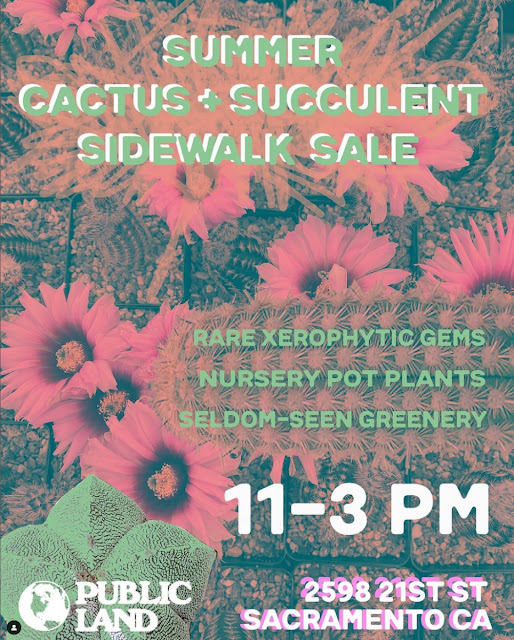
Public Land Summer Cactus + Succulent Sidewalk Sale
Image
Public Land Store  is a plant store and gallery in Sacramento’s Curtis Park neighborhood . As their website says, they “offer an eclectic assortment of unusual cacti, succulents and tropical house plants along with goods, collectables and original art from a wide range of artists who use various mediums to explore and re-imagine the ways we experience, interact and perceive our natural environment.” Last Sunday, Public Land had their Summer Cactus + Succulent Sidewalk Sale. A Facebook friend was wondering what a cactus sidewalk sale might look like, and I volunteered to investigate. Seeing how a picture is worth a thousand words – probably even more now, considering inflation – I herewith present my findings in photographic form: Public Land Store at the corner of 21st Street and 1st Avenue in Sacramento Tables on the sidewalk along 1st Avenue. Many of the plants were grown by Public Land co-owner Austin in his own greenhouse. The selection was cactus-heavy Every specimen I saw was...

Plants spending the winter inside

Image
While I don’t have any houseplants per se, I do bring plants inside for the winter. A few are too sensitive to be outside year round (like the plumeria you see on the extreme right in the photo below), others simply do better protected from the cold temperature. I’m not above admitting that I play favorites, so the plants that are invited to be houseguests for the winter are typically the ones I’m particularly fond of at the moment. Houseguests for the winter. The light you see all the way on the left is an OttLite floor lamp my wife picked up for free on Freecycle.org. Others are recent purchases that I want to give a head start. The bulk of the agaves you see in the next photo are recent purchases from Arid Lands Greenhouses . They were shipped bare root and need special TLC to get reestablished quickly. After repotting them in a very loose soil mixture, I put them on a seedling heat mat like this one . The mat warms the bottom of the pots, thereby stimulating root growth. I lig...

Fishtail palms at SFO

Image
Last night I was at San Francisco International Airport to pick up a family member. My favorite feature in the international arrivals hall is a long row of majestic fishtail palms. They are perfect plants for a major international airport because they suggest faraway exotic destinations.

String of pearls (Senecio rowleyanus)

Image
A few weeks ago I wrote about the plants I’m overwintering inside . I forgot to mention a few, and one of them is among the strangest succulents of all. Commonly called “string of pearls,” its botanical name is Senecio rowleyanus . It’s member of the giant genus Senecio which contains 1,250 species, not just succulents, but also common weeds (like groundsels ), wildflowers (like ragworts ) and even shrubs and small trees (such as Senecio cristobalensis ). “String of pearls” is a very good name, although to me its looks more like a string of peas. The spheres are modified leaves, and they grow on trailing stems that seem to go on forever. The leaves are round to reduce the surface area exposed to the hot sun and dry air, thus minimizing the loss of precious water through evaporation. In its natural habitat in southwestern Africa, the stems trail on the ground, rooting where they touch and forming dense mats. In cultivation, Senecio rowleyanus is almost always grown as a hanging plan...

Poinsettia in a can

Image
I made an exciting discovery today at our local Dollar Tree store where nothing costs more than—you guessed it—one dollar. A poinsettia in a can! First I thought it was a type of jack-in-the-box that jumps in your face when you open the can. Typically those are clowns, snakes, ghouls or other ghastly figures, but hey, it’s the holidays, so why not a euphorbia to startle you! But I was wrong, it is a miniature poinsettia growing station. Needless to say I was itching to get going. First I pull the tab on the bottom, which basically just creates a hole for the water to drain from. Then I pull the tab on the top which removes the entire lid. The “soil” inside the can looks to be 100% vermiculite. The instructions say to add 3-4 ounces of water… …place the seeds on top… …and cover them loosely with “soil.” The instructions state that sunlight is not required for germination so I put the can in a dark corner of my home office. Germination is supposed to take 14 days, so instead ...

Lucky again!

Image
Ever since my lucky bamboo died in June, it seems that my wheel of fortune has been on a slight downward tilt. The milk I use for my morning coffee seems to spoil more frequently than before, my socks have more holes than usual, and last week a mouse died in the ductwork of our Honda sedan (I’m not even going to describe the smell that’s currently permeating the interior). But all of that is going to change now. We attended a Bar Mitzvah celebration yesterday where every table was decorated with lucky bamboo centerpieces. At the end of the party, our friends asked us to take home as many as we wanted, so we ended up with seven! Seven is a lucky number, and lucky bamboo is a harbinger of good fortune, so we’re all set on our path towards all things good and wonderful.   I did some research to make sure our lucky bamboos will stay alive. Here’s what I gleaned: Keep your lucky bamboo in indirect light (bright or moderate light levels). Keep it away from direct sun. Lucky b...

(Not so) lucky bamboo

Image
After four years I’ve finally managed to kill our lucky bamboo. What’s surprising is not that it eventually died, but rather that it lived as long as it did. It was stuck on the edge of the bath tub in our guest bathroom where it was supposed to lend an exotic note to the décor. It was in a glass vase filled with pebbled and water, so in essence it was in water all the time (the recommended way of growing it). And for four years it was actually nice and green although it never saw sunlight—in fact the light level in that spot was pretty low. I’m not bemoaning its demise, but rather I’m singing its praises. It was as care- and maintenance-free as you could ever hope for. Which brings us to its unfortunate common name. Most people think lucky bamboo is a bamboo, but it isn’t at all. Its Latin name is Dracaena sanderiana , and it’s an understory plant native to the rainforests of Cameroon. I have no idea how an African jungle plant became associated with feng shui but millions of lucky...

Orchid Wednesday

Image
Usually I don’t pay much attention to houseplants, but when we were visiting my in-laws over Easter weekend, I couldn’t help but notice my mother-in-law’s orchids. Their beauty was so seductive that I didn’t even try to resist. Out came the camera, and these portraits are the result of our little tête-à-tête.             These are Phalaenopsis hybrids, commonly called “moth orchids” because the flowers are said to resemble moths in flight.They are native to Southeast Asia, and most of them are epiphytic, i.e. they grow on other plants, usually trees. That explains why in cultivation they’re not potted in soil but rather in a coarse medium typically consisting of bark, expanded clay pellets, or sphagnum moss. There are so many fascinating things to learn about orchids, and if I don’t stop myself now, there’s no telling where it might end! I will, however, recommend an orchid book that is as spellbinding as a good thri...