Posts

Showing posts with the label pests

Now it's f***ing personal

Image
The other day I walked into my greenhouse , perfectly relaxed and certainly not expecting anything bad. Imagine how p***ed I was when this greeted me: It got worse from there... ...much worse: Nothing left here! Weirdly enough, nothing else was eaten, just these Astrophytum cactus — and there definitely are other tasty morsels in the greenhouse. I don’t “collect” a lot of plants, but I did collect these astrophytums. I knew immediately who the culprit was. It’s always the same one. It starts with an r, has an a in the middle, and ends with a t. Let me spell it out: r-a-t. If you’ve followed my blog for any length of time, you might know that rats are my arch nemesis. They’ve done more damage in our garden over the years than anything else. Not just ornamentals: More than ¾ of the vegetables and herbs my wife planted in recent weeks have been gnawed down to stubs. Poison traps aren’t an option because of Stella, and I don’t love the idea of live traps: What am I going to do with a trap...

Caught red-handed

Image
For a while now, I’ve been noticing that the succulents in this planter are losing leaves at an alarming rate: What used to be a relatively lush grouping of sedums, aeoniums, and friends has become a place of sadness: My once proud Aeonium ‘Sunburst’ reduced to nubbins: I’d been putting the blame on rats because, well, because they’re my go-to scapegoats and always up to no good. But I was wrong. I finally caught the culprit in the act: Here it is, merrily chewing on a Senecio ‘Skyscraper’: It stopped momentarily when it saw me, but then it continued nibbling with no care in the world. Only when I got to within three feet did it scamper away. Here’s what’s left of Senecio ‘Skyscraper’: None of the succulents in this planter are irreplaceable so I’m letting the squirrels do their thing. I figure they need to fatten up now in preparation for winter. And I won’t apologize to the rats — I’m sure they’re responsible for something . © Gerhard Bock, 2025. All rights reserved. To receive a...

Not for the faint of heart

Image
My previous post was about one kind of agave-related affliction: edema caused by sudden changes in temperature and/or light level. This post is about another — one that is far more serious because it’s almost always fatal. I’m talking about the dreaded agave snout weevil. I wrote about it before: in a neighbor’s garden , and in my own . After my last encounter, back in December , I treated the agaves near the infested plant in my garden with imidacloprid, an insecticide that kills on contact and also works systemically. It was effective because I haven’t had any other problems in that bed. However (isn’t there always a however?), I didn’t go far enough. I should have treated all the agaves inside the front yard fence. Then my beloved Agave ‘Sun Glow’ in the bed next to the front door might still be alive. I noticed a while ago that ‘Sun Glow’ was leaning forward more than before. I have seen ‘Blue Glow’ (the non-variegated parent of ‘Sun Glow’) do that as the rosette gets heavier and...

NOOOOOOO – agave snout weevil sighting in my garden

Image
In August, I blogged about an agave snout weevil infestation in a friend’s house a couple of blocks away. I was definitely concerned about the agaves in my garden, but I didn’t notice any suspicious signs at the time. Maybe I didn’t take it seriously enough, didn’t look carefully. If I was too complacent, I no longer am now. The day of reckoning has come, because the agave snout weevil is officially here. Agave shawii × potatorum , a beautiful hybrid by Jeremy Spath I began with me noticing that the Agave shawii × potatorum in the front yard looked a bit lopsided. Granted, Agave shawii and hybrids involving Agave shawii often have a bit of a lean to them, as if they’re reaching for the sun. But the angle on this particular plant was more pronounced than you would expect. Sure enough, when I nudged it, it wiggled every which way – an agave firmly rooted into the ground wouldn’t do that. It took very little effort to lift the entire plant straight up. This is what I found on the unde...

Agave snout weevil is in the neighborhood

Image
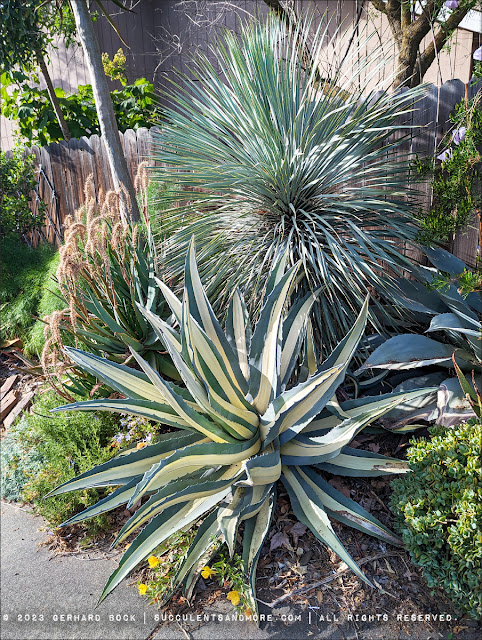
Once upon a time, my friend Darell, who lives a couple of blocks away, planted an Agave americana ‘Mediopicta alba’ much like the one below: Agave americana ‘Mediopicta alba’ in our garden (removed last year because it was encroaching into the sidewalk) A while ago, Darell had noticed that his Agave americana ‘Mediopicta alba’ didn’t look so hot: The lower leaves were turning black, and the upper leaves had begun to shrivel at the base. He doesn’t water very much, and initially he thought it was because of that. When I stopped by his place yesterday, I suggested he remove his  Agave americana  ‘Mediopicta alba’ and plant something nicer instead. For fun, I kicked the center of the agave with my foot. It wiggled so much, it was immediately clear that it wasn’t attached to the soil any longer. A stronger push with my foot knocked the entire plant over, exposing this gruesome sight: At the bottom, a hole in the ground. At the top, a spongy mess: When I lifted up the remaining bot...

Holly Krock's organic approach to treating agave mites

Image
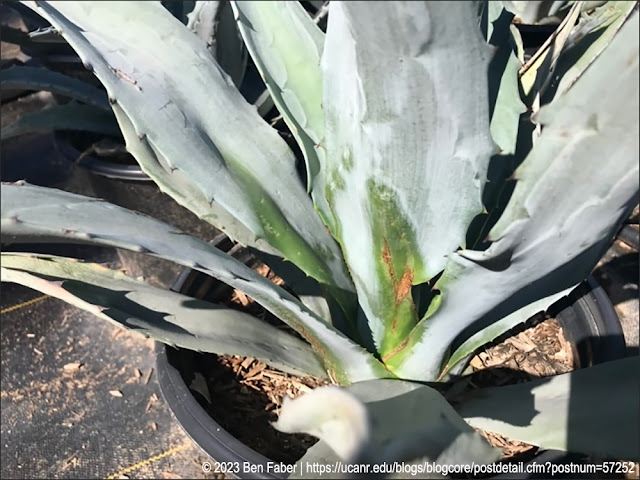
Everybody knows what aphids and mealybugs are and what a pest (literally) they can be. But many gardeners, including succulent collectors, have never heard of agave mites. Ignorance is bliss, until something like this shows up on an agave or mangave: Photo © 2023 Ben Faber | https://ucanr.edu/blogs/blogcore/postdetail.cfm?postnum=57252 The smudges that look like someone dragged a thumb dipped in grease across the leaf surface, and the scar-like lesions, are classic signs of an agave mite infestation. Agave mites, also known as grease mites (appropriate!), are tiny critters in the family  Eriophyidae . Adults are around 1/3 mm long, and their eggs are around 20 microns wide (that's 0.0008 inches). For comparison, a human hair has a thickness of approximately 70 microns, so the eggs of agave mites are 3× smaller. If the infestation is mild, the symptoms may seem purely cosmetic. Why worry, you might wonder, when agaves planted in the ground get all kinds of nicks and dings as a ...

Mealybugs (grrrr) on my 2nd tallest aloe

Image
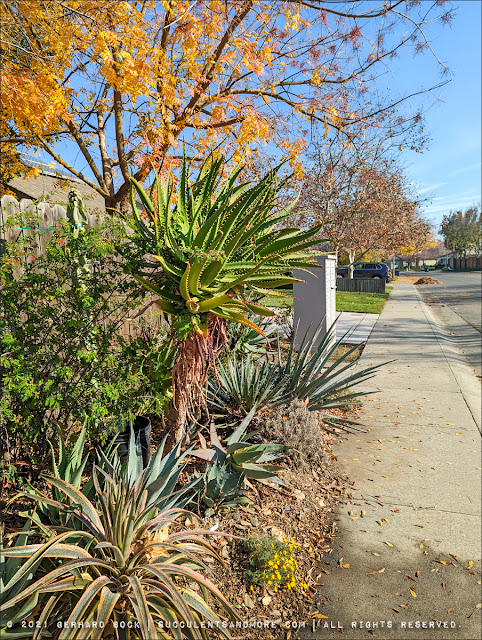
Mealybugs are the most persistent pest in our garden. Like aphids, they're often farmed by ants  who feed on the sugary waste the mealybugs produce. And since Davis is built on a giant ant hill, as I like to say, ants and mealybugs are a fact of life. Typically, mealybugs are the most active—and hence the biggest problem—from late spring to late fall when it's warm and dry. Mealybugs cannot survive freezing temperatures, but since we rarely have hard frosts, I suppose they just hunker down in their cottony cocoons. It may be December, but the days have been sunny and warm. I'm sure that suits the mealybugs just fine. They don't seem to be inclined to go into hibernation just yet. In fact, to my surprise, I noticed quite an infestation in our second tallest aloe, 'Erik the Red'.  From a distance, 'Erik the Red' looks great: But look inside the center of this one rosette: And behind it:  I have no clue why mealybugs prefer 'Erik the Red'. We have ...

Mealybugs win, agave loses

Image
Two years ago, I posted this photo of my Agave parryi var. truncata : It showed the beginnings of what would turn into a particularly insidious infestation of mealybugs, the bane of my existence as a gardener. It also marked the start of a multi-year war against these little  💩💩💩 . Fast forward to August 2018:

Sweetstuff’s Sassy Succulents June 2016 update

Image
Many of you follow Candy “Sweetstuff’s Sassy Succulents” Suter, either on her eponymous blog or on her popular Facebook page (18,000 likes and counting). Because of ongoing health issues, Candy hasn’t been as active on her blog or in her own garden, but she’s still very much a succulent fanatic. I visited Candy yesterday to help her with a very strange pest, and I’m happy to report that in spite of almost constant back pain, she is in good spirits and her garden looks great, a few weeds aside (who doesn’t have those!). Before we get to the mystery pest, let’s take a stroll in Candy’s backyard. Wherever you look, there are succulents, sometimes packed into objects that only loosely meet the definition of “container,” like this old Radio Flyer wagon: