Posts

Showing posts with the label dudleya

Odds and ends, late June 2024

Image
Quite a few of the photos I take in our garden never make it into any of my posts because they don’t fit a particular theme. But that doesn’t mean they’re not pretty / useful / interesting. Here’s a late June 2024 collection of some of these odds and ends. ~~~~~~~~~~ I’ve shown you a lot of blooming cacti in recent weeks, but those weren’t the only flowers in June. Here are a few others – even a green one. ⤥ Gasterias are South African succulents closely related to aloes (they’re able to cross-breed). The genus name comes from the Greek word for stomach, because the flowers are shaped like tiny stomachs. The flower below is from a Gasteria acinacifolia . Gasteria acinacifolia ⤥ Our Eucalyptus macrocarpa has been a shy bloomer, but it finally produced one of its spectacular flowers. I wish there were more, but it’s a beautiful plant even without flowers. Just look at these leaves! Eucalyptus macrocarpa There are two basic types of eucalyptus: gum trees (single-stemmed and massive) an...

Book review: Dudleyas by Jeremy Spath, Kelly Griffin, and Jeff Moore

Image
Dudleyas are a genus of succulent plants native to the coastal and inland regions of California and Baja California, Mexico. They are often found clinging to cliffs and rock outcrops where they survive on very little water – a testament to their remarkable resilience. With symmetrical rosettes that range in color from pure white to vibrant green, sometimes with reddish leaf edges, they are seductively beautiful. Even though dudleyas are found in many places from far northern California to the southern tip of Baja, they’re not well known among plant lovers, even in California native plant circles. Dudleyas did make the news in 2018 and 2019 after large-scale poaching of Dudleya farinosa  by foreign nationals had been discovered on the north coast of California. In response, legislation was passed in 2021 that provides important protections for dudleyas. To raise awareness, the California Native Plant Society has  introduced animated mascots for 18 California species. What fr...

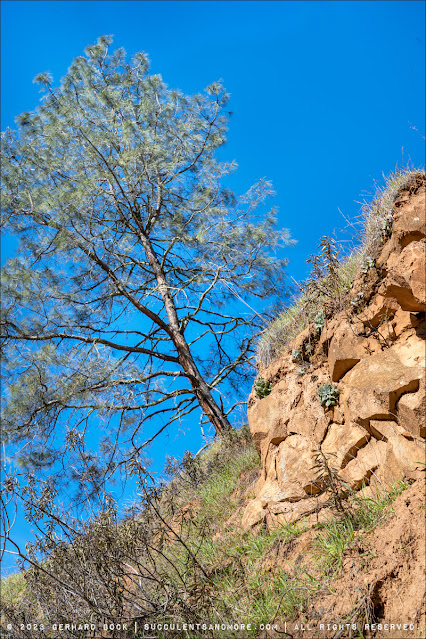
Dudleya cymosa in habitat in the Gold Country

Image
Last month my friend Kyle and I went on a field trip to the Gold Country to look at a population of Dudleya cymosa he had discovered earlier. The 50-mile drive from Sacramento takes you from the flats of the Sacramento Valley to the western slope of the Sierra Nevada, essentially from an elevation of 50 ft. to 1200 ft. The Gold Country is rich not only in history—the discovery of gold in 1848 triggered a major migration to California—but also in native flora. For me, as a succulent lover, the most exciting plant is Dudleya cymosa . It’s not exactly rare, not is it particularly beautiful, but it is the our closest native succulent. Ten years ago, only hardcore plant people knew what dudleyas were. Things are quite different now. National and international media coverage of the large-scale dudleya poaching uncovered in 2018 has raised public awareness of these modest plants and led to groundbreaking legislation to protect them (more info at the bottom of this post). Now dudleyas are...