Posts

Showing posts with the label Japanese garden

Lotusland 2024: everything but succulents

Image
Lotusland . The name alone evokes visions of an exotic place shrouded in mystery. And that’s exactly what it is: a fantastical garden full of mystique. Above all, Lotusland is the singular expression of one woman’s taste and tenacity. That woman was Ganna Walska, or Madame as she is still called today. Born Hanna Puacz in 1887 in the Polish town of Brest-Litovsk, then part of the Russian Empire, she changed her name to Ganna Walska when she entered the world of opera. Gifted with a remarkable voice and a passion for music, she pursued vocal training and made her debut as a singer in Warsaw at the age of 17. Her talent quickly garnered attention, leading her to perform in cities like St. Petersburg, Paris, and Vienna. Ganna Walska ca. 1941 It wasn’t just Ganna’s vocal prowess that captivated audiences; her striking beauty added to her allure. She became known not only for her singing, but also for her glamorous lifestyle, often mingling with high society figures and attracting admirers ...

Book review: Visionary Landscapes

Image
Think of a Japanese garden you've visited. What attributes come to mind? For me, it's tranquility, stillness, and self-reflection. You might say peace, meditation, a connection with nature. A refuge from the everyday world. Or you might feel transported to a faraway land that seems exotic and yet strangely familiar. In his introduction to Visionary Landscapes: Japanese Garden Design in North America  (Tuttle Publishing, 2017), Kendall Brown, Professor of Art History at California State University Long Beach, explains it like this: [T]hese gardens often exist as dreams of elsewhere and constructions of otherness. As microcosms of an idealized Japanese tradition, the landscapes can provide a compelling alternative to the banality of the here and now. Japanese gardens also serve as a kind of road home, a way of connecting us with idealizations of nature that restore us mentally and physically. Cover Attesting to the power of Japanese gardens, their popularity has spre...

Butchart Gardens on the cusp of spring

Image
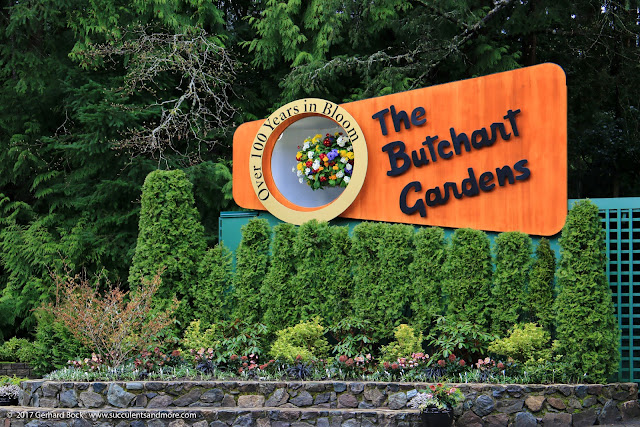
At the end of March, the Butchart Gardens , arguably North America's most popular public garden, should be a sea of flowering bulbs. Not so this year. "There has never been a year where we have so eagerly anticipated the arrival of spring in our garden," Rick Los, Director of Horticulture at the Butchart Gardens, writes in the Spring 2017 Garden Notebook : With all the talk of global warming we were expecting and planning for another early spring, but in a humbling change of events, Mother Nature decided to cool our region off significantly during the past few months. That being what it was, the garden itself did not suffer any unexpected physical damage. However, in comparison to last year, our floral calendar is almost a full month behind. Reading this was no surprise. That's pretty much the case across the Greater Victoria area and across the entire Pacific Northwest. I debated whether I even bother to go to the Butchart Gardens but then curiosity won out. I w...

Oasis of green: Bowyer Japanese garden

Image
The last garden my partner-in-crime Kathy Stoner and I visited during the Garden Conservancy’s Spring 2016 East Bay Open Day was the Bowyers’ Japanese garden in the hills of Orinda . After the artistic exuberance of Keeyla Meadows’s and Marcia Donahue’s gardens , this garden was like a palate-cleansing sorbet after a rich meal. I love riots of colors and textures as well as thoughtfully placed art objects that express the owner’s personal taste. However, after a while, the constant onslaught of visual stimulation becomes too much and I begin to long for the soothing tranquility of a space like the Bowyers’ garden.

Butchart Gardens, Victoria, BC

Image
With almost a million visitors a year, Butchart Gardens is the most popular botanical garden in all of North America. Talk to friends and relatives, and you’ll be surprised by how many of them have been there, even if it was a long time ago. Some of the infrastructure may have been upgraded (like the gift store and the coffee shop) and a few attractions may have been added (like the Rose Carousel) but the gardens themselves have most likely changed very little. With good reason. Why mess with success? When Butchart Gardens was started in 1904, it merely reflected the tastes of the time, ranging from the timidly playful to the rigidly formal. Today it seems like a living time capsule from a bygone era overlaid by a more-is-more aesthetic that seems to know no bounds. Like Willy Wonka’s Chocolate Factory, Butchart Gardens churns out one treat after another after another. Once you’ve started, you can’t stop. You go from one horticultural confection to the next, and even when you’ve rea...

#GBFling14: Portland Japanese Garden

Image
One of the gardens we visited during the recent Garden Bloggers Fling was the Portland Japanese Garden, surely one of the most spectacular public gardens in the country. I’d visited it twice before (see “Related Posts” at the bottom of the page) and knew what to expect. However, this is such a special place that it takes my breath away each time. I’ve covered the history of the Portland Japanese Garden in a previous post , but here is a quick recap: Opened in 1967, the Portland Japanese Garden has been called “one of the most authentic Japanese gardens outside of Japan” and “the most beautiful Japanese garden, not only in the United States, but in the world outside of Japan”. It encompasses five distinct areas, each of which corresponds to a specific garden style: Strolling Pond Garden, Natural Garden, Sand and Stone Garden, Flat Garden, and Tea Garden. Each style has a unique purpose, but they all are living reflections of Japanese history and culture.

Cor-Ten Zen

Image
Cor-Ten Zen was one of the properties I visited as part of the 2013 Marin County Open Garden Day organized by the Garden Conservancy . Here is the description from the official program: When asked to dream up a retaining wall design for the front garden of this Kentfield residence, designers Davis Dalbok and Tim O’Shea created a bold solution that would modernize the vernacular of the entire landscape, including the architecture of the home itself. Two ‘slices’ of Cor-Ten ribbon, with twelve feet of separation and a twelve-degree cant, were installed to visually support the steep slope. Counterbalanced by a large circular steel portal -- or ‘moongate’ -- to the garden beyond, the elemental, Cor-Ten themed design soon expanded to capture the car gate, an original mailbox design, chimney cover, a column at the front entry and, thin, weight- appropriate cladding over the garage door. Eventually, it was decided to circumscribe the entire house with a bold, perforated band of Cor-Ten stee...

Ganna Walska Lotusland 1

Image
Together with the Huntington Botanical Gardens in San Marino, Lotusland has been at the top of my must-see list for many years. Needless to say it was the destination I was looking forward to the most on our recent trip to Santa Barbara . Entrance on Cold Springs Rd Ganna Walska Lotusland , as it is officially called, is located in Montecito , a few miles south of Santa Barbara. The 37-acre property was purchased by former opera diva and wealthy socialite Madame Ganna Walska in 1941 for $40,000. She originally named it Tibetland with the intention of creating a retreat for Tibetan priests. The priests never came—they were unable to travel to the U.S. because of World War II—and Ganna Walska’s marriage to her 6th husband soon fell apart. Turning her back on men for good, she decided to invest all her energy and her considerable fortune—the spoils of several very lucrative divorces—into creating a botanical wonderland unlike anything that had ever been done before. Entrance on Col...

UC Botanical Garden—Asian Collection

Image
On my recent visit to the UC Botanical Garden (UCBG) in Berkeley, I first strolled through the Southern African Collection where many aloes were blooming and then through the New World Desert Collection with its myriad agaves, yuccas, cacti, and terrestrial bromeliads. After so much spikiness, I was ready for something more gentle. Fortunately, I didn’t have far to go because the Asian Collection borders both the Southern African and New World Desert Collection. The contrast couldn’t have been greater. One of the first sights I saw when entering this verdant forested environment, was this: Dawn redwood ( Metasequoia glyptostroboides ) along Strawberry Creek in the Asian Collection

A collector’s garden

Image
Yesterday I had the opportunity to visit the garden of Sue Fitz, a fellow plant collector here in Davis. The day started out mostly overcast, a rare thing for us in the summer, so I was able to take photos that hopefully do her garden justice. I jokingly told Sue that her garden looked like an Annie’s Annuals catalog come to life. That’s actually not far from the truth: Many of her plants originally came from Annie’s, and her garden is eclectic and refuses to be put into a single category. Parts of it look like an English cottage garden, others resemble the kind of tropical plantings you might find in Florida or Hawaii. And in the back of her ¼ acre lot is a small Japanese garden complete with a torii gate and bamboo fence. Panorama of Sue Fitz’s garden The first thing I noticed as I walked into Sue’s garden is a tree so bizarre that I found myself circling back to it on several occasions:               ...