Posts

Showing posts with the label terrestrial bromeliads

Blood, sweat, and bromeliads: tackling an overgrown dyckia clump

Image
One of the plants Kyle and I got from San Marcos Growers on our recent Santa Barbara trip is Dyckia platyphylla . This terrestrial bromeliad is attractive, easy to grow, hardy for a dyckia (15-20°F), and yet hard to find. I don’t know why. Maybe because dyckias in general don’t get much love? Both Kyle and I think it would make a great landscape plant in zone 8b and up. We bought three 2-gallon pots of Dyckia platyphylla at San Marcos, intending to divide the clumps into individual plants for future sales. Three dense clumps of Dyckia platyphylla I decided to tackle one of the clumps to see how easy (or hard) it is to divide: Many individual rosettes... ...packed together tightly Below is the unpotted clump. I had recently watered it, but you wouldn’t know looking at the root ball. It was so dense that water wasn’t able to penetrate it to any meaningful degree. Since the root ball was so dry, I soaked it overnight: Better. The next step was to assemble the tools: my Root Slayer soil...

This and that, mid-July 2026

Image
Sometimes it seems not much is happening, but when I look at my photos, I realize there’s more going on than I give the garden, the plants, and myself credit for. On that note, another “This and that” post with random sightings that I hope you’ll find interesting. BROMELIAD FLOWERS I’ve lost most of the tags on my bromeliads so I can’t tell you what these are, other than Neoregelia and Billbergia , but the flowers are cool because they’re so different from the other kinds of flowers I usually see. Many neoregelias produce a flush of color in the center just before they start to bloom The flowers themselves are tiny and barely emerge from the cup. The leaves blush in vibrant colors to attract pollinators, which might otherwise have a hard time finding the inconspicuous flowers. In contrast to neoregelias, billbergia flowers are highly visible They emerge from the center on a long stem and feature colorful petals (red in this case) and bracts (greenish yellow, pink, and purple on this o...

Hechtia vs. Dyckia

Image
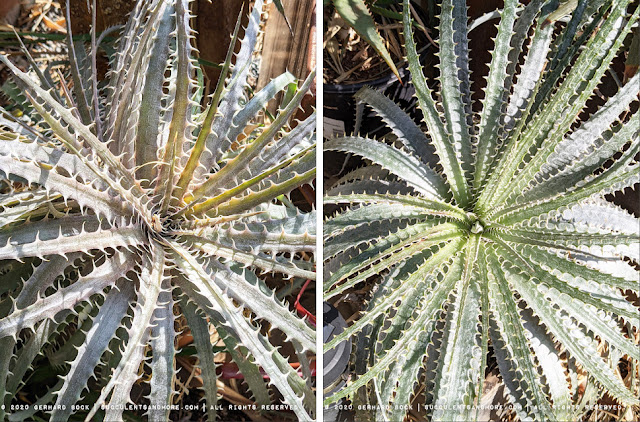
My previous post on Hechtia lanata raised a common question: how do hechtias differ from dyckias? Both are terrestrial bromeliads (like pineapples), both form rosettes of remarkable beauty, often in large clusters, and both are fiercely armed with barbed teeth along the leaf margins. Visually, they’re difficult to distinguish, as the following example demonstrates: Dyckia delicata (left), Hechtia argentea (right) Some more juxtapositions of hechtias and dyckias to highlight their similarities in terms of general appearance: ↷   Hechtia ‘Wildfire’ vs. Dyckia ‘Arizona’ × ‘Brittlestar’ F2 Hechtia ‘Wildfire’ ( H. texensis × stenopetala ) Dyckia ‘Arizona’ × ‘Brittlestar’ F2 ↷   Hechtia ‘Aztec Sun’ vs. Dyckia ‘Tibor’ Hechtia ‘Aztec Sun’ Dyckia ‘Tibor’ ↷   Hechtia fosteriana vs. Dyckia pulquinensis Hechtia fosteriana Dyckia pulquinensis ↷   Hechtia lanata vs. Dyckia platyphylla Hechtia lanata (smooth-leaved form) Dyckia platyphylla (photo from dyckiabrazil.blogsp...