Posts

Showing posts with the label aloe removal

Aloe excelsa removed, diagnosed, treated, and convalescing
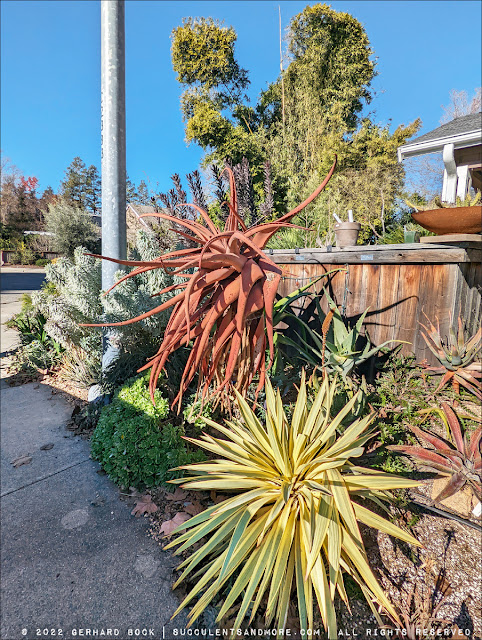
Image
Over the last year or so, I've periodically shown photos of our Aloe excelsa , located in the long L-shaped bed along the sidewalk. While it's common for this species to assume a reddish hue in the winter, it should revert to green in the summer, especially when watered. Ours has been stuck on red for a year and half now, prompting this recent comment by a reader:  “[Y]our excelsa is definitely having issues. It should green up in summer and only take on color in the cooler season. There’s healthy red on plump leaves and then there’s death throes red on a starved, declining plant. My guess is either this is a living crown on a dead stem (tree-type aloe stems seem to be more frost sensitive than the crown) or there aren’t much feeder roots and only anchoring roots. It just seems like it’s not taking up water at all. You might inspect around the crown in the dead leaves for aerial roots trying to make their way down to the soil. If you find them, that stem is indeed dead.” JM, th...

Gravity always wins, part 2

Image
Once upon a time, we had a beautiful Aloe marlothii  growing in the bed along the sidewalk. Its leaves were well armed with prickles on top and underneath, and in the winter, the whole plant flushed a stunning pink:  And then one day (this morning, to be precise), the fairy tale was over: The aloe was lying flat on its face, the stem snapped off at ground level: The cause? Gravity, at least in part. This aloe, about 10 years old now, was planted on a slight slope. For the first few years of its life, it had been growing out towards the sun because its top had been shaded by a clumping bamboo. This year, even though its leaves were on the deflated side—the plant's water reserves fairly depleted after a dry winter and spring—the rosette on top of the 2-ft. stem was still heavy. Given these conditions, it wasn't that difficult for gravity to have its way. A recurring irrigation issue may have made matters worse. Two sections of ¼-inch drip irrigation tubing inside the fence ...