Posts

Showing posts with the label history

Snapshots from Nuremberg, Germany, May 2023
Image
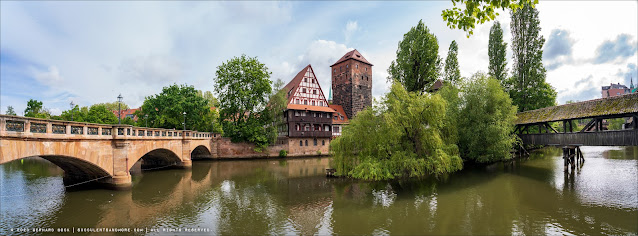
Nürnberg, or Nuremberg in English, is the closest “big city” to my hometown of Hersbruck ( see this post ). Downtown Nuremberg is just 20 miles away, a 30-40-minute drive depending on traffic. The smarter choice is to hop on a train, which takes just 15 minutes. And unlike elsewhere (here’s looking at you, Amtrak), trains are plentiful and generally on time. Along the River Pegnitz Nuremberg has a rich history that stretches back over a thousand years. The city’s story began in the Middle Ages when it emerged as a major center of trade and commerce in the Holy Roman Empire . In the 11th century, Nuremberg became an imperial city, granting it a considerable degree of autonomy and self-governance. The city flourished as a hub for manufacturing and craftsmanship, particularly in metalworking, textiles, and printing. It also became renowned for its annual trade fairs, attracting merchants from across Europe. During the Renaissance, Nuremberg was home to artists such as Albrecht Dürer , a p...
Chasing Centuries: top agave book of 2018

Image
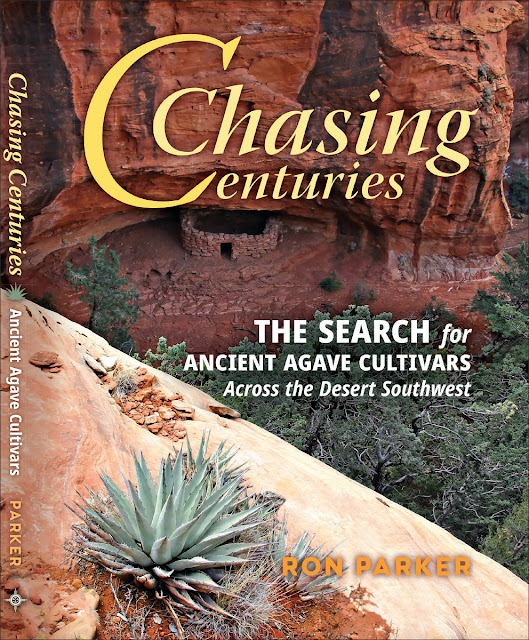
Considering how few books there are about agaves (I reviewed four in this post ), any new volume about my favorite plant group is a reason for celebration. Even better when it's a truly original book—one that goes where no other book has gone before.  Chasing Centuries: The Search for Ancient Agave Cultivars Across the Desert Southwest  (Sunbelt Publications, January 2019) by Ron Parker does just that. A few years ago, Ron and Greg Starr took me on a  hike in the Waterman Mountains  northwest of Tucson to see  Agave deserti var. simplex  growing in habitat. Ron talked at length about his travels all over Arizona to document endemic agave populations, especially domesticated agaves—cultivated by pre-Columbian cultures for food and myriad other uses. I could tell this wasn't just a casual interest for Ron. It was a passion. Ron was driven, the way all explorers are, to go further, look harder, dig deeper. You might call it an obsession, but it's the go...

Europe 2017: German Alps, day 3

Image
Day 3 of our stay in the Bavarian Alps was spent in the Berchtesgaden area. As is the case with so many exceptionally beautiful places in the world, Berchtesgaden is overloved and overrun, especially in the summer, leading to heavy traffic and disgruntled drivers looking for parking. Still, I can't blame anybody coming here to enjoy this slice of paradise. After all, we were part of that crowd. Bergfriedhof Church in the town of Schönau which borders Berchtesgaden to the south

Europe 2017: Picture postcards from Nuremberg, Germany

Image
With a population of 510,000,  Nuremberg (German: Nürnberg) is Germany's 14th largest city . It's about 20 miles from my hometown, a quick-and-easy 16 minutes by train. It's always been my favorite "big city" in Germany, not only because it's the one I know best, but because the historic city center is so picturesque. View from Nuremberg Castle As the site of the Nazi Party's Nuremberg Rallies , the city was a major target for Allied forces in WWII and sustained extensive damage. Many structures were rebuilt, including the main churches in the city center. Today, Nuremberg is an important economic powerhouse, both in industrial production and advanced technologies. In addition, Nuremberg has always been a center of the arts and sciences and is home to major museums such as the Germanisches Nationalmuseum , Germany's largest museum of cultural history, and the Spielzeugmuseum , one of the best-known toy museums in the world. My favorite thing ...

Adak, Alaska: day 4

Image
Wednesday, September 9, 2015 Cousin Shannon convinces me to get up early so I can photograph the sunrise. We head over to the fuel farm and walk out on the pier. Just in time. The clouds light up with the drama I was hoping for. It doesn’t last long, but I do get a photo of god rays: The wind is picking up and, combined with a slight drizzle, I’m feeling uncomfortable for the first time since I got here. Ever so briefly, I get a sense of how nasty the wind must be when it really blows. Fortunately, the wind and rain don’t last long. That’s pretty much my experience with any kind of weather on Adak: Wait a few minutes and it’ll change. That’s what they say about Hawaii, too.

Adak, Alaska: day 3

Image
Tuesday, September 8, 2015 Day 3 on the island and I’m falling into a routine. Get up at 8 a.m. just before the sun rises, have coffee, do some work, then head out for a little walk before meeting up with Elaine at noon. This morning I don’t have much time because of work. I can never really get away from it unless I go to a place that has no Internet at all. But even Adak, population 100+, has Internet although it’s expensive. Another surprise: There’s decent cell phone coverage, even away from town. But only on AT&T. As a T-Mobile customer, I get no signal whatsoever. I must admit it feels strange being disconnected from the world like that. Strange, but healthy. This morning I check out the abandoned McDonald’s in town. This was once the westernmost McDonald’s in the world. As you can see below, the building itself is in almost perfect condition. As is the inside, from what I can see through the window. Apparently the building is still used for civic functions so the city ke...

Adak, Alaska: day 2

Image
Monday, September 7, 2015 (Labor Day) Since the sun doesn’t rise until 8:15 a.m. and I’d had an eventful first day on Adak, I sleep in and then go for a walk in the neighborhood. The houses in this subdivision are basically all the same: either off-white with a blue roof, or tan with a red roof. All of them have a solarium attached to the dining room. It feels a bit like an afterthought because it’s not really integrated into house; instead you access it through a door as if you were stepping outside. The solarium isn’t heated so you wouldn’t be very comfortable sitting out there in the winter unless you bring a portable heater. But it could be used to grow plants because temperatures don’t drop much below freezing here. I don’t know how many people have used their solarium for that purpose, but I cannot imagine that among the thousands of people who’ve lived in these housing units over the years there haven’t been a least a few with a green thumb. However, I see no sign of garde...

Adak, Alaska: day 1

Image
From this teaser you may know that I recently spent time on Adak in the Aleutians , a chain of 69 islands, many of them volcanic, extending 1,200 miles from the mainland of Alaska towards the Kamchatka Peninsula in Russia. Here’s a map to give you a better idea: I love numbers, so let me throw some out for you. Adak is: 2,700 miles from the north pole 2,700 miles from Davis, California where I live 1,300 miles from Anchorage, the biggest city in Alaska 870 miles from the Kamchatka Peninsula in Russia 450 miles from Dutch Harbor , the nearest inhabited place in the Aleutian Islands (if you’ve ever watched the reality TV series Deadliest Catch , you might have heard of it) At the same latitude as Vancouver, British Columbia Horticulturally speaking, in USDA hardiness zone 8, the same as Portland, Oregon and Seattle, Washington; Anchorage, in comparison, is in zone 4; Fairbanks, in south-central Alaska, in zone 2 Between the Bering Sea to the north and the North Pacific Oc...

Gardens at Mission San Juan Capistrano

Image
When most Californians think of Mission San Juan Capistrano , they think of swallows. Every spring, legions of American cliff swallows return to Mission San Juan Capistrano after spending the winter in Argentina 6,000 miles away. Local legend claims that once upon a time a local innkeeper chased the swallows away by destroying their nests, and they took up refuge at the mission nearby, In 1910s, a savvy priest at the mission used the public’s interest in the swallows to generate support for his restoration efforts. Without Father O’Sullivan the mission might not be what it is today. In 1939, composer Leon René wrote a song called “When the Swallows Come Back to Capistrano” that has lived on until today. I had wanted to see Mission San Juan Capistrano for a long time. There hadn’t been an opportunity to visit until this April when on our way home from our spring break trip to San Diego we drove right through the town of San Juan Capistrano . I expected a sleepy mission, but much to ...

Howdy, Old Town San Diego

Image
I’ve lived in California almost three decades, and this was my first visit to San Diego. I still can’t believe it took me this long, especially since San Diego is reputed to have the best gardening climate in all of California. The winters are mild and so are the summers, especially along the coast. The city of San Diego has an average of 201 days above 70°F, according to Wikipedia . We had just three days in San Diego during our spring break vacation so we only scratched the surface. But what a surface it is! The waterfront is stunning, Balboa Park a jewel, but my favorite spot was Old Town , parts of which are now a State Historic Park . The San Diego Presidio , established in 1769 on a bluff north of what is now Old Town, was the first European settlement on the west coast of the the present day U.S. The first of the California missions was built the same year on the same bluff, and by 1820 a small pueblo had sprung up below. In 1850, California joined the United States and the ...

Hawaii: Kona is for chillin’

Image
Kona (or Kailua-Kona as the post office calls it) is the main town on the western side of Hawaii. It was established in 1812 by King Kamehameha I as the capital of the new Kingdom of Hawaiʻi . After the capital moved on to Lāhainā and then to Honolulu, Kona was primarily a vacation retreat of the royal family and a sleeping fishing village. It wasn’t until the 20th century that tourism transformed the town (and the entire area). Today Kona is a major hub of commerce and tourism, and the island’s biggest airport is located just to the north. We had been skirting Kona all week on our way to other places, like Puʻuhonua o Hōnaunau and the Mountain Thunder Coffee Plantation . Yesterday we decided to visit downtown proper to see what it was like. I didn’t think Kona was as fancy as Carmel-by-the-Sea in California, and I was right. In fact, Kona was refreshingly unpretentious; very laid back, a tiny bit rough around the edges, but with a good vibe. I enjoyed walking around in spite of th...