Posts

Showing posts with the label Agave pumila

More agave/aloe musical chairs in our garden

Image
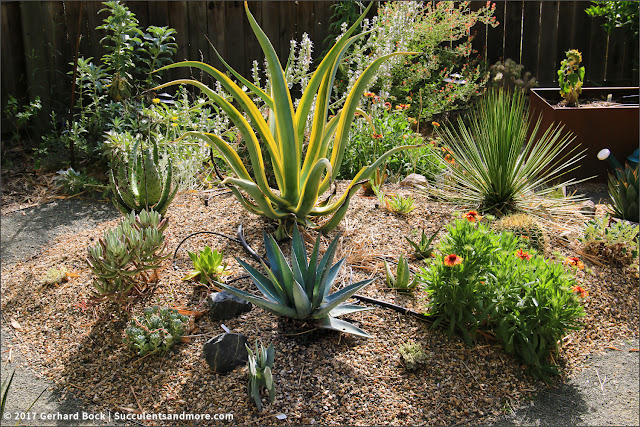
This post continues where  Propping up a large leaning Aloe globuligemma × marlothii left off. In fact, in the two photos below, you can see the newly erect aloe in the upper left: Agave pumila in the center As I mentioned in my Aloe globuligemma × marlothii post, the next plant I was going to tackle was the Agave pumila nearby, seen in the center and bottom of the two photos above. This agave sustained quite a bit of damage from rot in the extra wet winter of 2016/2017 but pulled through. While I respect its resilience, its time had come—I just wasn't “feeling” it anymore the way I once had. With in-ground real estate at a premium, I've become quite brutal at rotating out plants no longer in favor.
Rotting Agave pumila pulls through

Image
In January, I noticed that a few leaves on my prized Agave pumila in the front yard had started to rot . The seemingly non-stop rain in January was simply too much. (In total we had over 30 inches of rain this winter--10 inches more than our historic average.) I first applied a fungicide in hopes of stopping the infection but that didn't seem to do very much. I was thiiiiiis close to removing the entire plant but pity got the better of me and I decided to give it one last chance. I pulled off the rotten leaves--they practically came off in my hands--when to my surprise I noticed a handful of babies hiding underneath. There was no way I could get rid of the mama now! Fast forward 3+ months to May 24. This is what my Agave pumila looks like now:

Succulents rotting in drought-busting rain

Image
After 5 years of drought--one for the record books, no less--the pendulum has swung far to the other side. After more or less normal rainfall in November and December 2016 (5.10 inches as per the UC Davis Weather Station ), the floodgates opened wide in January, with no end in sight. In January we had 13.30 inches of rain, and in February 6.90 so far (February 1-18). That's a total of 20.20 inches for the first seven weeks of 2017; essentially the same amount we had during the entire 2016 calendar year (20.07 inches). Virtually all of our succulents are planted in well-draining soil (garden soil heavily amended with inorganic materials such as pumice, lava rock or small gravel). This has allowed them to withstand months of wet soil. So far we haven't had any plants rotting from the bottom up. But the 25.30 inches of rain that has fallen since November has had a damaging effect in other ways. A few agaves and aloes have started to rot from the top down. The first major victi...

Agave pumila rot—can it be stopped?

Image
Once upon a time, I had a perfect agave I loved very much. While it wasn't exactly rare, it was definitely uncommon, especially at this size. Its name was Agave pumila : I bought it in March 2016 at Grow Nursery in Cambria on the Central Coast of California and planted it in the ground in the smaller of the two succulent mounds that replaced our front lawn .

Blue

Image
Green leaves are the norm. Yellow, orange, red or purple leaves can be interesting or just plain weird. But blue—blue leaves make me go weak at the knees. A bluish cast is the result of either a waxy coating or irregular microscopic projections from the epidermal cells that reflect sunlight. It’s easy to tell what it is. Simply touch a leaf, and if the bluish color goes away, it was wax. These mechanisms protect the plant either from water loss or from sun damage. Desert-adapted plants are more likely to have bluish leaves than tropical plants growing in environments where water is abundant. Makes sense, doesn’t it? So without further ado, here are some of the plants with glaucous foliage in my garden. Coincidentally, all of them are succulents. Yucca rigida Agave pygmae ‘Dragon Toes’

Two new agaves in my collection

Image
Yesterday I introduced you to our new whale’s tongue agave ( Agave ovatifolia ‘Vanzie’). Even as a youngster it’s a large specimen already, 2 ft. across, so it went in the ground in the back yard. Today I want to show you two other agaves I bought recently. Both are small and will stay small, so I’m keeping them in containers. The first is Agave pumila . This one is a bit of a collector’s item in that it is fairly difficult to find. It’s a very slow-growing species, which agave expert Howard Gentry speculated might be a natural hybrid between Agave lechuguilla and Agave victoria-reginae . It has two distinct stages: the juvenile stage characterized by a 2-4 inch rosette of short, stubby leaves (the form typically encountered in potted plants), and an adult stage with an open rosette of 16-18 inch elongated leaves. It has never been known to flower. Cold hardiness is nothing to write home about, about 28°F, but that’s not really an issue with such a small potted plant—simply bring i...