Posts

Showing posts with the label protea

FINALLY a fertilizer for proteas thanks to Waltzing Matilija

Image
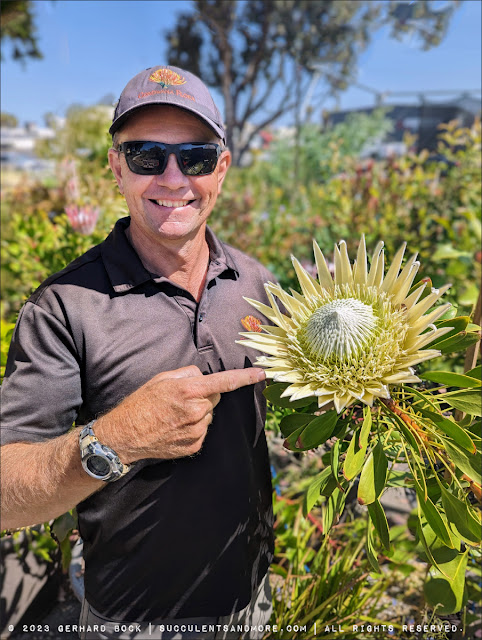
While most of the posts on Succulents and More are about succulents, some fall into the “more” category. This is one of them. My love affair with the Proteaceae family (informally referred to as “proteas”) goes back a long time. Over the years. I’ve grown the most common members in my garden: Protea , Leucadendron , and Leucospermum from South Africa as well as Banksia , Grevillea , and Hakea from Australia. As beautiful as they are, they do have some special requirements you need to know in order to be successful with them. Above all, they’re intolerant of too much phosphorus in the soil so general-purpose fertilizers can harm or even kill them. (They still need phosphorus, just not at the levels usually present here in California.) In Australia and South Africa, protea fertilizer is widely available. Not so here. Until recently, nobody in the U.S. manufactured fertilizer specially formulated for proteas. My friend Troy McGregor, Australian-born plantsman extraordinaire and owner o...
Troy McGregor's free guide to protea care

Image
If you’ve been following my blog for any length of time, you have heard me mention Troy McGregor. I first met Troy when he was the manager of the nursery at the Ruth Bancroft Garden, a good 10 years ago . He was instrumental in growing what used to be a small plant sale area into a specialty nursery known all over Northern California for its excellent selection of succulents and water-wise plants, including a large variety of shrubs from Australia and South Africa. Since then, he’s established Gondwana Flora , a landscape design and build company specializing in climate-appropriate front yard transformations. Waltzing Matilija Nursery began in 2018 as an extension of Gondwana Flora. “I was unable to find many of the plants I love to landscape (and garden) with,” Troy said when I spoke with him last year, “so I started to grow my own. One thing leads to another and now here we are.” Troy with Protea ‘Arctic Ice’ In 2021, Troy moved Waltzing Matilija to its current location, a ½ acre l...

Visit to Waltzing Matilija Nursery

Image
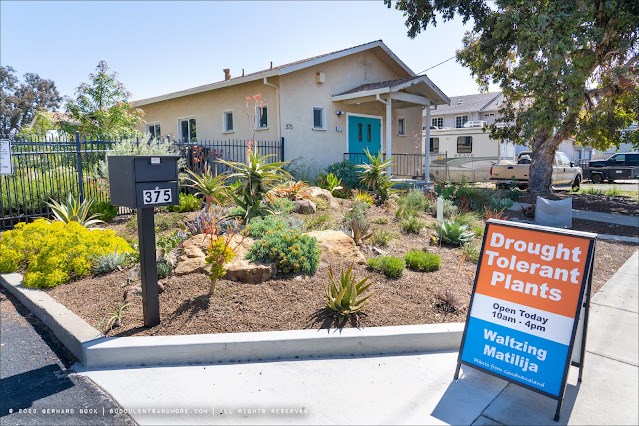
In April, I mentioned that East Bay landscape designer and plantsman Troy McGregor was opening his nursery, Waltzing Matilija , to walk-in customers every Friday and Saturday through July 8. ( Here is my post in case you missed it.) Last Friday, my friend Michele and I made the 1-hour drive to Pittsburg to pick up some plants Troy had put aside for us. That gave me the opportunity to take photos of the display garden and of the nursery itself. Waltzing Matilija Nursery is hard to miss as you drive down Central Avenue in Pittsburg: Just keep an eye out for the display beds on both side of the entrance. Troy installed them less than two years ago as a showcase for drought-tolerant plants, and they’re filling in nicely. The plants are a wonderfully eclectic combination of succulents and Australian and South African natives. (Troy is from Australia and propagates many rare plants from Down Under.) The display garden is a living business card for Troy’s business, advertising to potenti...

Smoke-filled visit to Troy McGregor's fusion garden

Image
Last Saturday the air quality index in Northern California was firmly in the unhealthy-bordering-on-hazardous range. Not as bad as in Southern California, Oregon and Washington, but still bad enough.  Not that I let myself be stopped by that. Sick of being cooped up inside, I made the 1-hour drive to Martinez to pick up some plants from plantsman extraordinaire Troy McGregor, former nursery manager at the Ruth Bancroft Garden and now in business for himself creating low-water landscapes. Troy is one of the chief enablers of my plant hoarding; may the universe bless him for that. I've blogged about Troy's garden before ( October 2018  ⏐ September 2018  ⏐  April 2018 ), but it's constantly evolving so there's always something new to see. Troy used the downtime resulting from COVID-19 restrictions earlier in the year very well—all too often, landscape designers have no time for their own space. The biggest change is the addition of a chicken coop in the backyard. But i...

UC Santa Cruz Arboretum in late winter: South African Garden

Image
The University of California Santa Cruz Arboretum  is arguably the best place in Northern California to see plants from the southern hemisphere (especially South Africa and Australia) in all their glory. The mild coastal climate is virtually frost-free in the winter and rarely gets above 80°F in the summer. These are ideal growing conditions. Heck, I'm not a plant, and I want to live there! My recent trip to Santa Cruz was successful in every respect. I drove down in an empty car and came back with a trunk full of plants. But more on that in part 2. My partner in crime on this trip was my friend Brian who volunteers at the Ruth Bancroft Garden. He's as plant-obsessed as I am and shares my fondness for Proteacea. Brian doesn't take as many photos as I do, but he was very patient with me. (I do move at a snail's pace when I'm in plant viewing mode.) Late winter is a particularly good time to visit the UC Santa Cruz Arboretum because many members of the Proteac...

The Wave Garden in Point Richmond: one of my favorite spots in the Bay Area

Image
The Wave Garden in Point Richmond  may be one of the best kept secrets in the Bay Area. There seems to be some hesitation to share its exact location. Maybe it's because the Wave Garden is privately owned even though it's open to the public and meant to be enjoyed by the wider community. More on the history of this unique place a little later. I visited the Wave Garden in February 2014  and again in May 2015  and had been wanting to go back ever since. Since it's only 15 minutes from Annie's Annuals and Perennials, I caught two birds with one stone last weekend. After spending a couple of hours shopping at Annie's , I made the short drive to Point Richmond. As on my previous visits, there was nobody else there. For an hour I enjoyed what has to be one of the most scenic and peaceful spots on the east side of San Francisco Bay. One of several seating areas, this one overlooking the Richmond-San Rafael Bridge  crossing San Pablo Bay

More R&R in the front yard

Image
Not rest & relaxation. The other R&R: removal & replacement. Before, there were two sprawling salvias: Salvia mexicana ‘Limelight’ and Salvia canariensis . I love both of them, and I wouldn’t have taken them out if they’d been half as big and half as vigorous. But they were clearly in the wrong place here so I finally made the hard decision to say goodbye. Sorry, hummingbirds, I know the ‘Limelight’ was a popular hangout.

Meanwhile, on the homefront…

Image
From my recent posts, sparse as they have been, you might have gotten the impression that I haven’t been home much. Actually, I have been, but work has been unexpectedly busy, exacerbated by the forced absence of my business partner who has had to take PTO to be with an ailing parent overseas. Gardening has been sporadic, but I have been taking photos. I’ve even started on a couple of projects in the backyard, relegated to also-ran status in recent years. All that is about to change, as you will see in a separate post later this week. For now, let’s take a look at the front yard, specifically what used to be the front lawn . This is what you see as you approach from the driveway (literally steps behind the spot from which I took this photo). I don’t think I’ll ever get tired of this view. It’s everything I had hoped for.

Australian and Succulent Garden at UC Santa Cruz Arboretum (summer 2016 edition)

Image
Two weeks ago I made a quick trip to the University of California Santa Cruz Arboretum. I’ve already posted about the beauties in the South African Garden . Now it’s time to take a look at what caught my eye in the Australian Garden. I’ll also show you a few photos from the small Succulent Garden, and we’ll end our visit at Norrie’s, the gift and plant shop near the parking lot. Yes, I did buy a few goodies to bring home. In contrast to the South African Garden, which had a ton going on even in the middle of summer, the Australian Garden was a bit more subdued. Fall seems to be a better time, based on my limited experience . Now that doesn’t mean the Australian Garden was boring. Far from it. Many grevilleas were blooming (when aren’t they?), and the gum trees are spectacular year round. Let’s take a look.

South African splendor at UC Santa Cruz Arboretum (summer 2016 edition)

Image
Noël Coward once suggested than only mad dogs and Englishmen go out in the midday sun. Something similar could be said for plant geeks who visit botanical gardens at the height of summer. I'm definitely one of them. And I'm not even slightly bothered by the fact that some people might consider us crazy. Case in point: Last Saturday I left Davis before 7:00 a.m. to make the 2 hr. 15 min. drive to Santa Cruz , one of my favorite places on the California coast. My destination wasn't the beach though, it was the University of California Santa Cruz (UCSC) Arboretum . I hadn't been there since November 2012 —almost four years ago—and I felt the urge to find out what might be in bloom in the middle of the summer. Protea repens ‘Rubens’ In their own words, the UCSC Arboretum “has the largest collection of Australian and South African plants outside of their native countries” as well as “the most diverse collection of eucalyptus and their relatives to be found in one easy-t...

Book review: Protea: A Guide to Cultivated Species and Varieties

Image
Writing more book reviews is always near the top of my want-to-do list for this blog. I don’t have a good reason why I haven’t followed through, but I promise that I’m going to do better. And it will start right now. Years ago I became interested in the protea family (Proteaceae), which includes my favorite shrubs such as proteas, leucadendrons and leucospermums from South Africa, and grevilleas and banksias from Australia. However, the authoritative reference book on these wonderful plants, The Protea Book: A Guide to Cultivated Proteaceae by Lewis J. Matthews (Timber Press 2002), was long out print and was commanding astronomical prices on the second-hand market. Fortunately, Lewis Matthews has now written a new book that is both an update and a sequel to the original: Protea: A Guide to Cultivated Species and Varieties was published in June 2016 by University of Hawai'i Press. On the left: Grevillea ‘Flora Mason’ At 232 pages, it’s not a massive tome but it includes a wea...

Perfect flower on Leucospermum ‘Goldie’

Image
It’s no secret that I love the Proteaceae family. Most of these Southern Hemisphere shrubs—think of the sugarbushes (proteas), conebushes (leucadendrons) and pincushions (leucospermus) from South Africa, or grevilleas and banksias from Australia, to name just a few—have beautiful foliage, stunning flowers or both. The pincushions (leucospermums) aren’t all that blessed in the leaf department, but they more than make up for it with their stunning inflorescences. Just take a look at some of the images on Google to see what I mean! Unfortunately, leucospermums have proven challenging to grow here in Davis. Unlike leucadendrons, grevilleas and banksias, with which I’ve had good luck, leucospermums seem to be more sensitive to the summer heat and winter cold (even in a mild-winter climate like ours). My beloved Leucospermum ‘Scarlet Ribbon’ died a sudden death last summer, probably because the spot it was in was too hot. Leucospermum cuneiforme ‘Goldie’ flower on April 21, 2016 But ...