Yucca ‘Bright Star’ is one of those plants that stop you in your tracks the first time you see them. It’s just that beautiful. I had one from 2017 to 2023 and have been looking for another one ever since.
My original ‘Bright Star’ came from my friend Hoover Boo (Piece of Eden) in Southern California. After seeing hers (here), I knew I needed to have one. Fortunately, she had a source and was able to get me a 2-gallon plant. It bloomed for the first time in November 2022, producing a glorious display of bell-shaped flowers.
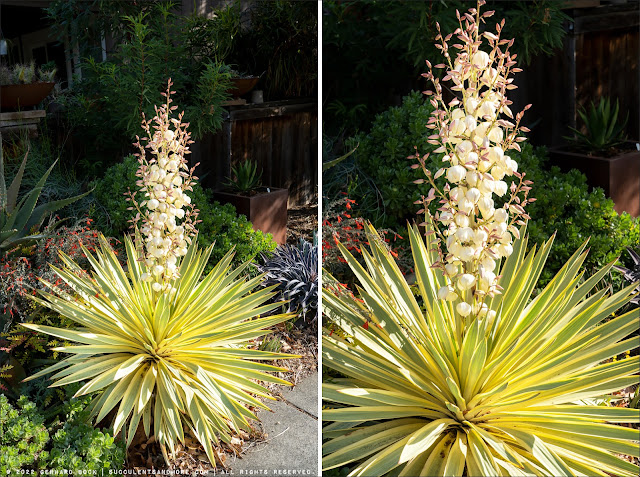 |
| November 2022 |
Yuccas are polycarpic, meaning they don’t die after flowering like most agaves do. Technically, I could have enjoyed this stunning spectacle every year from then on.
Unfortunately, my ‘Bright Star’ split into multiple heads after flowering, ruining the beautiful symmetry of a single rosette.
It got even worse when I noticed suckers popping up around the mother plant:
I had visions of a messy clump — most definitely not the look I wanted. I knew I would get annoyed every time I walked by, so I took a deep breath, got out my Root Slayer, and dug it all up in July 2023.
I saved three heads with no roots and two suckers with some roots and potted them up. However, none of them survived. No matter what some Internet sources say, I don’t think rooting yucca offsets is all that easy.
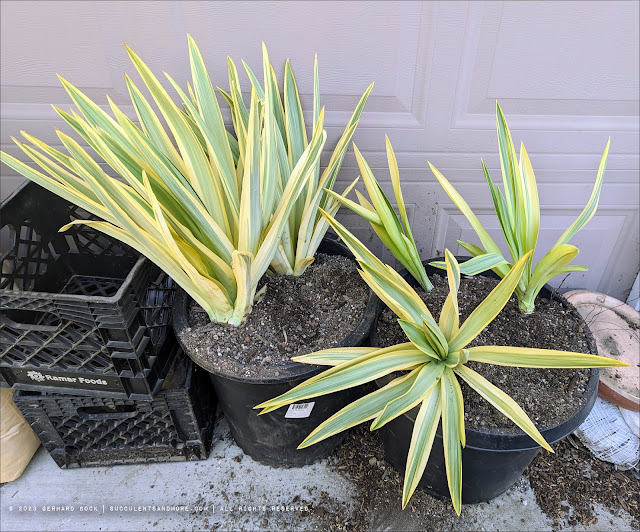 |
| Three heads (no roots), two suckers (some roots) potted up, but ultimately doomed |
After I removed my ‘Bright Star’, it didn’t take long for me to want another one, especially since I was seeing it in quite a few gardens. Maybe I was simply noticing it more?
Yucca ‘Bright Star’ has never been widely available in Northern California, but for a few years it seemed to be gone entirely. Possibly because the plant patent on ‘Bright Star’ expired in 2025 (see the note at the end of this post) and anybody is now able to propagate it freely? Maybe growers were holding back their stock to release it after the expiration date?
That would make sense, because ‘Bright Star’ is now available again. A long-time follower of Succulents and More, Neal, messaged me just last week to let know that he had seen dozens of them at
Devil Mountain, a large wholesale nursery with 15 locations throughout California. The grower is
Matsuda’s, a subsidiary of
Green Acres, a Sacramento area retail nursery. Last Saturday, I happened to be in Sacramento so I checked the closest Green Acres location. And there they were:
 |
| Yucca ‘Bright Star’ at the Sacramento location of Green Acres |
At $42.50, they’re not cheap, but they’re good-sized plants in 3-gallon containers:
I hemmed and hawed a bit, wishing I could find one for less money in a 1 gallon, but I don’t remember ever seeing ‘Bright Star’ in smaller sizes.
In spite of my initial hesitation, I bought one, and when I got home, I immediately planted it in a 16"
Veradek Demi Planter I had picked up at my local Costco warehouse for $24.99 (a steal).
For now, it lives next to the small cactus bed in the backyard. I don’t think this is its forever spot, but that’s where it’ll stay until I figure out its ultimate home.
I’m happy I finally have another ‘Bright Star’. And when it does eventually flower and split, maybe I’ll have more luck rooting a few heads or offsets.
In case you’re interested, here’s some background info on
Yucca ‘Bright Star’, based on a deep dive I did
a few years ago. According to
Google Patents, the plant now known as ‘Bright Star’ was discovered in 2000 by U.K. nurseryman Tim Crowther:
“Each year, the inventor propagates Yucca by removing the side shoots, commonly known as ‘pups’, from the base of the stems of the parent plants of variegated Yucca gloriosa (unpatented). In 2000, in the course of this propagation, the inventor observed one side shoot whose rosette of foliage was atypical of the parent. Approximately one half side of this atypical rosette exhibited a greater degree of golden variegation. The inventor removed this one side shoot with the intention of attempting to produce a new plant form whose entire rosette would exhibit a uniformly more golden variegation. The inventor rooted the first-discovered side shoot and removed its growing point in order to encourage rapid basal side shoot production. In 2001, the inventor observed that three side shoots had arisen with varying degrees of golden variegation. The inventor observed that one of these three side shoots exhibited a uniform and significant degree of golden variegation. This one side shoot, ‘WALBRISTAR’, was removed and transferred to the inventor’s tissue culture laboratory where it was successfully initiated into culture and then multiplied by the same method of removing basal shoot cuttings, but in vitro.”
The patent was applied for in December 2005, granted in April 2007, and expired in December 2025. Presumably, Yucca ‘WALBRISTAR’ (aka ‘Bright Star’, the name used for marketing purposes) can now be propagated by anybody without having to pay royalties.
Since the patent application was filed, the botanical name Yucca gloriosa var. recurvifolia has changed. According to Plants of the World Online, operated by the Royal Botanical Gardens, Kew, Yucca gloriosa var. recurvifolia and Yucca recurvifolia are now considered synonyms of Yucca gloriosa var. tristis, so presumably the correct name of the plant is now Yucca gloriosa var. tristis ‘Bright Star’.
Finally, in case you were wondering how much money the holder of a plant patent stands to make off a patented plant: The royalty for something like Yucca ‘Bright Star’ is likely between $0.25 and $1 per plant. This is the license fee you would get from companies that propagate your plant commercially. That doesn’t seem like much, but it’s all a numbers game.
© Gerhard Bock, 2026. All rights reserved. To receive all new posts by email, please subscribe here.


I had my Yucca 'Bright Star' in a pot for over 10 years before I transplanted it in the ground. It had lots of rhizomes that had not surfaced so I planted some of them in my daughter's garden in Walnut Creek this past fall. No signs of life yet but am hoping for the best! This article is making me think it is more difficult than I thought : (
ReplyDeleteJust because I wasn't successful doesn't mean it won't work for you :-)
DeleteThe mature specimens in these pics are stunning. Yours is also looking fabulous in the tall Costco container. That’s a great look.
ReplyDeleteThank you! I think I'll go the container round this time.
DeleteIt is gorgeous. You've convinced me I need one ;). What a great deal on the planter!
ReplyDeleteCheck your local Costco for those planters!
DeleteJim B.here.
ReplyDeleteI finally planted my Bright Star in the ground a couple of weeks ago after years in a pot. It had a volunteer Euphorbia cotinifolia also growing in the same pot and I wanted to try and grow it as screen lower in the garden. I decided to just plant them both in the ground rather than separating them. But when we pulled it out of the pot, i found all of these little side nubs underground. One even had some leaves. So I cut them off with a few roots, let them dry out, and potted them up.
After reading your story about trying to root cuttings, I’m now worried that I will get nothing. But hopefully they will send out more roots and leaves and I’ll have 5 new plants someday.
Fingers crossed. Please keep me posted. According to the Internet, it shouldn't be that hard to root these offsets - even if I failed. But I've failed at many things :-)
DeleteI'll have to look into whether 'Bright Star' has reappeared here in SoCal. My 2 remaining plants are in relatively sad condition and I do love them.
ReplyDeleteMaybe give your plants a bit more water in the summer? Yuccas like water when they're in active growth.
DeleteGiving your experience in 2023, is there anything you would do differently the next time around? Maybe if you let the off-shoots get bigger before you dig them up? This is such an elegant Yucca, especially in the new black pot.
ReplyDeleteChavli
Yes, I would definitely wait until the offsets are bigger before separating them. I think larger offsets have a much better chance of rerooting.
DeleteThis has always been a difficult yucca for me in SoCal. Just can't get the siting and watering right. A shame cuz when it's good, it's so very very good. If/when the price comes down I can experiment with more of them. Gail's slope grows them beautifully.
ReplyDeleteAgreed, if you could get 1-gallon plants at a good price, I'd be happy to experiment as well.
Delete