One of my gardening goals for 2026 is to critically assess every plant in the garden, especially in the coveted sidewalk bed in the front, and be ruthless: Any plant that doesn’t do it for me anymore gets pulled and replaced with something more compelling. I know, that sounds a bit silly, but it’s what I need to do to keep things exciting.
As with any new year’s resolution, there’s no guarantee that it will last, but I’m determined to at least give it a try. And I’m happy to report that I’ve completed the first removal of the year.
My target was the blob in the middle:
 |
| Nolina texana |
It’s Texas beargrass or sacahuiste (Nolina texana). As Wikipedia puts it so poetically, Nolina texana “is a plant in the asparagus family that resembles a large clump of grass.” That’s what it looks like although it isn’t a grass at all but rather a relative of agaves, yuccas, and dasylirions.
My Nolina texana was just a little thing when I brought it home in my suitcase from the 2018 Garden Bloggers Fling in Austin, Texas.
 |
| Nolina texana when I brought it home from Austin in May 2018 |
What attracted me were the wispy tufts at the end of the leaves. They became more pronounced as the plant bulked up:
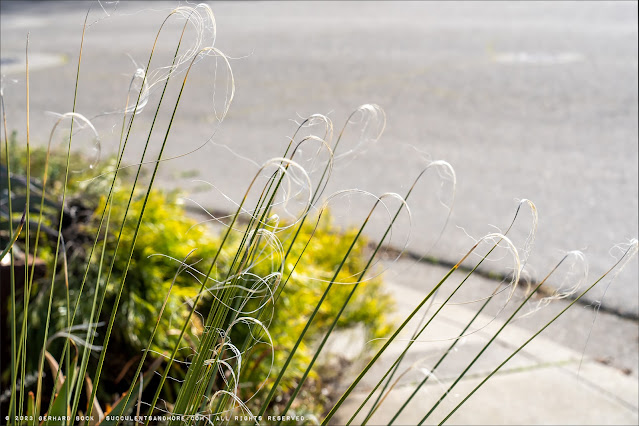 |
| February 2023 |
A couple of years ago, it flowered for the first time, and I was disappointed:
 |
| Nolina texana inflorescence |
Because the inflorescence is so short, it’s semi-hidden inside the leaves. Beyond that, it’s simply not very attractive (OK, it’s dead ugly). Compare that to the
stately inflorescence of Nolina nelsonii:
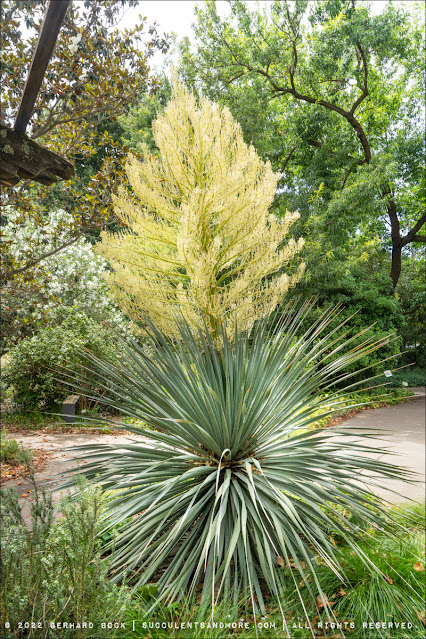 |
| Now that is an impressive display! |
For years, I loved having Nolina texana in that spot because it provided a welcome contrast to the spiky aloes and agaves around it.
However, after almost 8 years in the ground, it had simply gotten too large and too messy, all but obscuring the Aloe speciosa hybrid behind it:
 |
| ... was almost hidden behind Nolina texana |
 |
| From certain angles, Nolina texana was still a pretty part of the overall picture, which is why this decision wasn’t easy |
I thought I would be able to simply lift up the root ball using my
Root Slayer, but it wasn’t that straightforward. The first step was to trim off enough leaves to allow access:
Then I proceeded to chop away at the clump with the Root Slayer, prying out piece after piece. The work wasn’t challenging, but it took a little while.
This is what the spot looks like afterwards:
Now you can actually see the trunk of my Aloe speciosa × barberae:
 |
| Aloe speciosa × barberae getting ready to flower |
In addition, Agave yucuanensis, which had been partially hidden by Nolina texana, is fully visible:
This beautiful agave species was
formally described less than two years ago by Greg Starr. It was originally discovered by
Jeremy Spath and
Tony Krock on a mountainside near San Bartolomé Yucuañe in northern Oaxaca (hence the species name).
The next question, of course, is obvious: What will go in the spot formerly occupied by
Nolina texana? The answer is not so obvious. Right now, I’m leaning towards planting the
Hesperaloe parviflora ‘Straight Up’ you see in the next photo. This
High Country Gardens introduction has “strongly upright growing flower spikes” that are less floppy than the species. Since it’s sterile, it flowers much longer because it doesn’t have to put energy into making seeds. In the summer, it would take center stage; in the winter, when the flower stalks are gone, it would cede the attention to
Aloe speciosa ×
barberae.
 |
| Hesperaloe parviflora ‘Straight Up’ |
Hesperaloe parviflora, commonly called red yucca even though it’s not a yucca (nor an aloe), forms a clump of grass-like foliage superficially similar to Nolina texana but less tall and more open. I like that it would provide a soft counterpoint to the pricklier plants around it without becoming a dense blob like Nolina texana had. Maybe I’ll simply plant it and live with it for a while to see how I like it.
 |
| Fog this morning |
The photo above has nothing to do with the topic of this post, but I wanted to include it anyway. We’ve had a string of beautiful sunny days, but in the morning, between 5 and 8 am, we often have fog. This morning, it was so thick that our house seemed to float in mid-air. Quite a surreal view!
© Gerhard Bock, 2026. All rights reserved. To receive all new posts by email, please subscribe here.


Good call! Nolina nelsonii is magnificent, Nolina texana not so much.
ReplyDeleteIt has its place, but not in my garden.
DeleteIt looked nice before, but I agree the removal was a good choice. That agave & Aloe sxb are gorgeous and deserve the spotlight! I look forward to seeing 'Straight Up' flowering in the summer, your border is bold - it should hold it's own. That fog, ugh - I'm glad to hear it's burning off nice and early. That's not typical right?
ReplyDeleteThis type of fog used to be common 20 years ago. Not so much in recent years.
DeleteI've heard that fog was more common 20-30 years ago because air quality was so much worse, and water droplets had more "surface" to condense on with all the particulates floating around! Those Priusses? Prii? really do make a difference with our air quality.
DeleteI've planted a few hesperaloe recently and can attest that the leaves do sprawl and flop. They never seem to bloom for me and they're not often seen in the urban areas here so it's a bit of an experiment. Funny, when you wrote from certain angles the nolina still looks pretty, that's exactly what I thought! But overall a good call to make and strong start to 2026 garden goals. Very sunny here the past few days, mid 80s -- your fog looks good to me!
ReplyDeleteHesperaloes need high heat to thrive. It's probably not warm enough in your LB garden.
DeleteMid 80s! I can only dream of that!
Ha! You got right to it didn't you? While I thought the grassy blades were a nice contrast to the spikes all around, I do agree it's better without it. I will second what Denise said, the foliage on my Hesperaloe was rarely upright, but rather floppy, never an issue with the flower spikes though, they were always standing tall. I also learned that the key to Hesperaloe blooms is summer water... (Mr. Hogan advised and he was right).
ReplyDeleteHesperaloe parviflora has rather floppy foliage, but it's much more sparse than Nolina texana.
DeleteI second what Sean said about summer water. Hesperaloes are perfectly adapted to winter-dry/summer-wet climates. Mine will get watered in the summer, but it'll still be a few years before it will flower. I still have the Hesperaloe parviflora 'Sandia Glow' I bought in Austin 2018!
I need to take a leaf out of your book and be more ruthless! Trouble is, I feel sorry for the discarded plant and therefore need to dig it up, pot it up and find a happy home for it with someone else. All those steps mean I am rarely motivated to follow through. Sigh.
ReplyDeleteElly
Ps your fog is very Game of Thrones-esque!
DeleteI know what you mean. I try to rehome plants as much as possible. I tried to remove the Nolina texana whole, but the only way I got it out was by destroying it.
DeleteI'm sorry our Central Texas native nolina didn't work for you, Gerhard, especially since it was a souvenir from the Austin Fling. I've actually never seen one that looks like yours. In my garden and elsewhere (I'll try to link to a photo I took at the Lady Bird Johnson Wildflower Center), Texas nolina droops languidly like spaghetti. It looks great on a wall or slope so it can cascade like it wants to do. Yours was odd the way it stood up with those dry-looking ends on the leaves. It's true that the inflorescence is tucked tight on that nolina. Lindheimer's nolina, another Central Texas native, is more upright in leaf and flower -- but still not as showy as nonnative Nolina nelsonii, which is sadly not reliably winter hardy in Austin. It's a beauty though! https://www.penick.net/digging/images/2014_06_18/11_Nolina_&_opuntia.JPG
ReplyDeleteI enjoyed Nolina texana for 8 years. That's a lot longer than other plants have lasted :-) Plus, I still have the Hesperaloe parviflora 'Sandia Glow' I got in Austin from that one nursery you took us to (I forgot the name).
DeleteI can see how the decision would be a difficult one but once done it was the right one. The negative space between the larger plants lets them shine. Something low and spreading would look great and continue to enhance the larger shapes.
ReplyDelete