With cold nights and sunny days, the weather is pretty much back to what you would expect for this time of year. There isn’t much going on right now, so I decided to take a look at what the garden was like in early January last year, the year before, etc. Memories fade, but the blog is here to help me remember.
For each year, I’m giving the nighttime low, the daytime high, and the mean low and mean high as per the UC Davis Weather & Climate Station.
2025
Nighttime low: 29° (January 21)
Daytime high: 70° (January 10)
Mean: low 38°, high 62°
Nights below freezing: 7
I could have sworn that aloe flowers were further along a year ago. They were, a little (surprising, considering it was a fairly cold month), but not as much as I had thought.
 |
| Aloe excelsa, January 2025 |
 |
| Aloe excelsa, January 2026 |
 |
| Aloe speciosa × barberae, January 2025. It didn’t flower at all last year... |
 |
| ...but it will this year |
 |
| Eastern end of the sidewalk bed — January 2025 |
 |
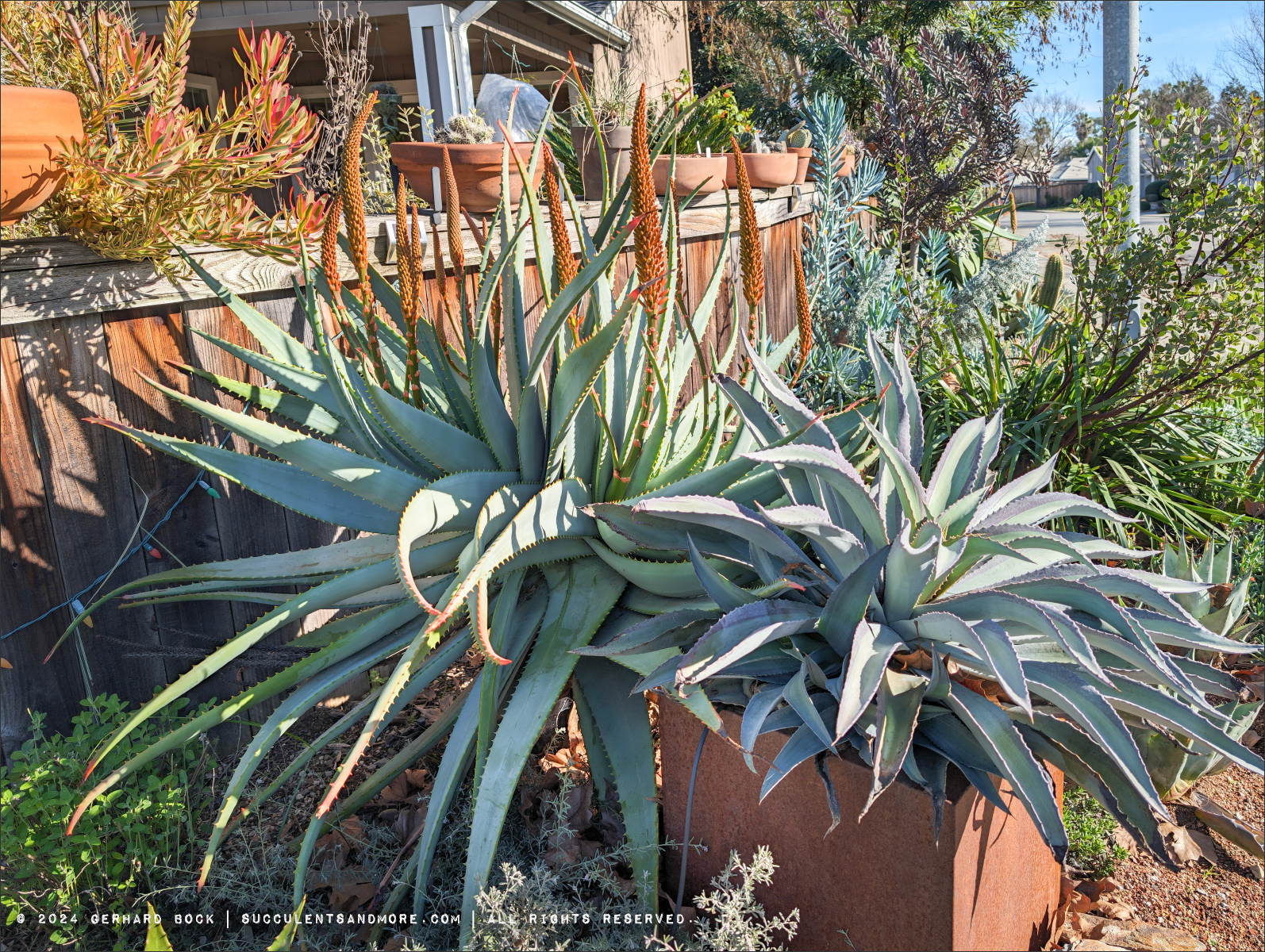
| January 2026 — it looks pretty much the same, except the house is a different color. As for aloes, ‘Erik the Red’, vaombe × spectabilis, and ‘Moonglow’ are just weeks away from flowering. |
2024
Nighttime low: 34° (January 7)
Daytime high: 72° (January 29)
Mean: low 43°, high 60°
Nights below freezing: 0
Temperatures didn’t drop below freezing in January 2024. This is what I wrote on January 11, 2024: “It’s no secret that winter is my least favorite season. But this winter has been as mild as any I can remember: According to the UC Davis weather station, the December 2023 low was 31°F (Dec. 11), with 3.57" of precipitation, vs. a December 2022 low of 27°F (twice) and 5.88" of precipitation – these four degrees make a big difference! In January 2024, the lowest temperature so far has been 34°F, with just 0.62" of rainfall. Winter has many more weeks to go, of course, but for mid-January, things are looking good.”
For some reason, I didn’t take a lot of pictures of the garden in January 2024. As I was going through the photos I do have, what jumped out at me were plants that looked great then but are gone now — a vivid reminder that the garden is always in flux.
 |
| Aloidendron ramosissimum ended up rotting (too much water in the summer). I was able to save a few cuttings, but it’ll be years before they look like this. |

|
| Both Aloe ‘Tangerine’ (left) and ×Mangave ‘Queen for a Day’ are no longer there. Aloe ‘Tangerine’ had two massive heads, and when I tried to remove the one on the right, which was pushing on the metal container, I accidentally cut right down the middle so both heads were severed. I was so mad I tossed all the pieces in the yard waste. |
 |
| ×Mangave ‘Queen for a Day’ rotted because the Corten container wasn’t draining well, but I was able to save it. It’s in a nursery pot now, waiting to be moved to a new spot. |
 |
| What this corner looks like now (January 2026) |
 |
| ×Mangave ‘Mission to Mars’ looked great in winter and spring, but in the summer the leaves turned yellow and folded in on themselves. It looked dead ugly (see here), which is why I took it out. At some point, I’ll try another one in a less exposed spot, but for now, the garden is ‘Mission to Mars’-less. |
 |
| Aloe peglerae × mawii flowered for the first time in 2024 (and again in 2025), but it looks like it will skip this year. Some plants are predictably unpredictable! |
2023
Nighttime low: 29° (January 21)
Daytime high: 67° (January 26)
Mean: low 39°, high 57°
Nights below freezing: 5
The biggest worry in January 2022 was damage in the wake of a cold and damp December 2022. This is what I wrote in January 2023: “This December [was] colder than usual, both in terms of nighttime lows and daytime highs. Above all, we had two nights, December 18 and 19, when the lows dropped to 27°F—a temperature I don’t recall seeing in 5+ years. For reasons I don’t have a scientific explanation for, many of the tender succulents I grow are perfectly fine at 28°F, but start showing leaf damage below that. This is exacerbated by surface and soil moisture, something we’ve had plenty in the second half December.”
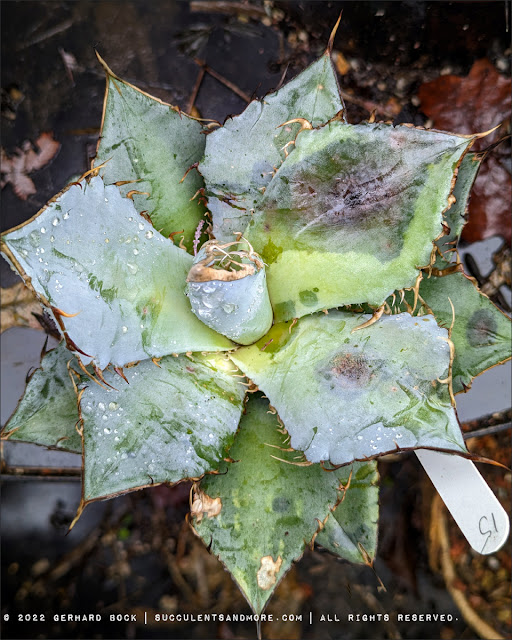 |
| Agave titanota ‘Blue Sphere’. The rot eventually spread to the core, which spelled the end of this beautiful agave. |
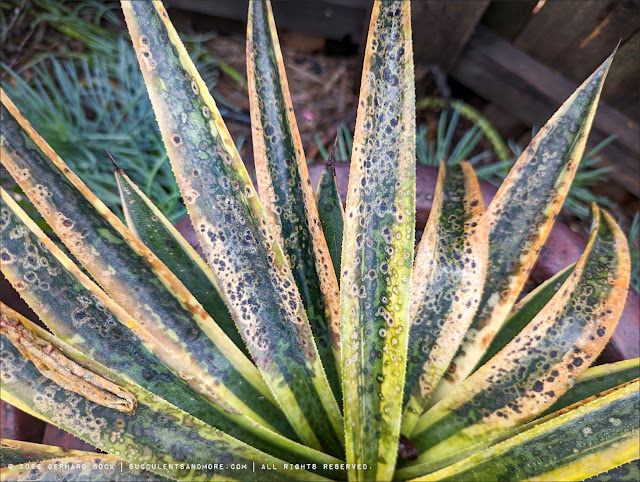 |
| Mangave ‘Pineapple Punch’. It survived, shedding the damaged leaves over time — except that it’s about to flower now and die. Hopefully there will be some pups under the main rosette. |
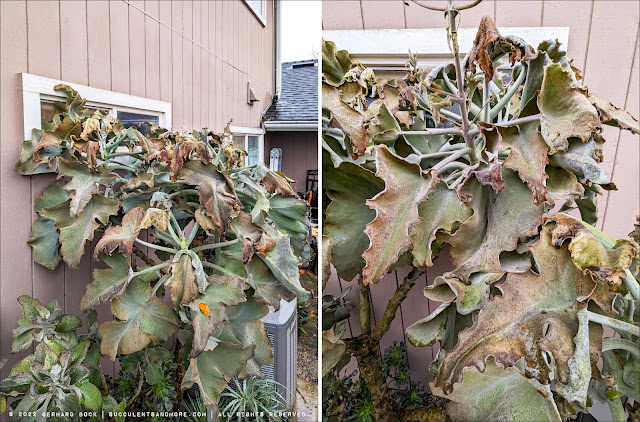 |
| Kalanchoe beharensis ended up being a goner |
2022
Nighttime low: 30° (January 2)
Daytime high: 70° (January 23)
Mean: low 37°, high 62°
Nights below freezing: 1
January 2022 was quite dry and warm. Aloe flowers were definitely further along, as you can see in the photo below. What is also noticeable: many plants aren’t there anymore. The one constant is change, right?
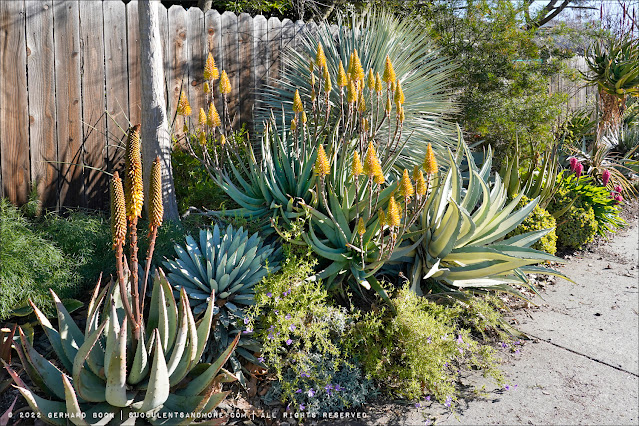 |
| Gone (left to right): Aloe petricola (rot), Agave macroacantha (removed because it took up too much space and was constantly full of debris), Agave americana ‘Mediopicta alba’ (removed because it protruded too far into the sidewalk) |
 |
| January 2026 |
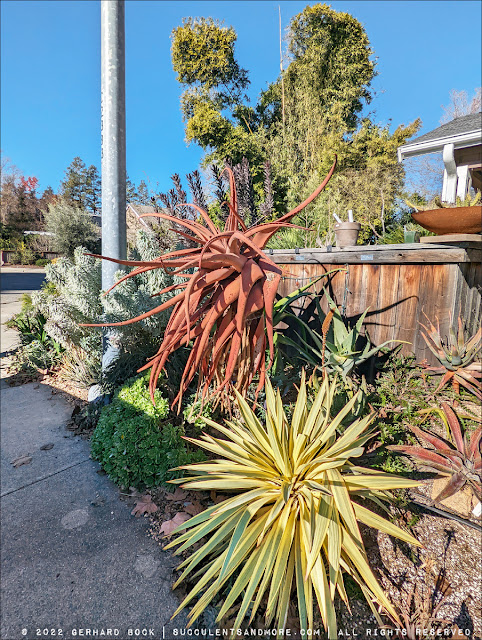 |
| Pretty much everything you see in this January 2022 photo is gone (minus the bamboo in the background). Yucca ‘Bright Star’ (which I loved dearly) eventually flowered and split into multiple heads, which destroyed its symmetry. Aloe excelsa (looking like a copper sculpture) had already rotted at the base. I pulled it out, cut off the rotted section of stem, rerooted it, and planted it around the corner, where it has thrived. Like last year, it’s going to put on quite a flower show this year (see photos at the top of this post). Larger aloes are much easier to rescue when they start to rot because they have a lot more reserves to draw on. |
 |
| Same spot in January 2026. Three plants dominate: Leucadendron ‘Ebony’ in the back, Aloe ‘Yemeni Gold’ in the center, and ×Mangave ‘Bloodspot’ × Agave titanota at bottom right. |
2020
Nighttime low: 34° (January 7)
Daytime high: 68° (January 27)
Mean: low 40°, high 58°
Nights below freezing: 1
On January 18, 2020, I wrote: “The first two weeks of January have been unpleasantly damp and chilly here in the Sacramento Valley. [...] All I want is a few days of unadulterated sunshine. I’m not alo(n)e in this: Our aloes have been in a holding pattern for weeks now. They need a good spell of afternoon highs in the 60s to kick the flowering action into high gear. On the positive side—at least as far as aloe flowers are concerned—we haven’t had enough rain to cause the ends of the immature inflorescences to rot. In fact, our rainfall has been modest since the official start of winter.”
The part about aloes being in a holding pattern sounds just like this year. For comparison:
 |
| January 2020 |
 |
| January 2026 |
2014
Nighttime low: 29° (January 16)
Daytime high: 75° (January 25)
Mean: low 36°, high 67°
Nights below freezing: 9
For fun, I jumped back all the way to January 2014. 2013 had been the driest year on record in California, and 2014 didn’t start out much better. In fact, the word “drought” was on everybody’s mind.
How different things are this year. Just this morning (January 9, 2026), a
headline in the Los Angeles Times proclaimed: “California is free of all drought, dryness for first time in 25 years.” The article goes on to say, “After experiencing one of the wettest holiday seasons on record, still soggy California hit a major milestone this week — having zero areas of abnormal dryness for the first time in 25 years.”
Looking at photos from January 2014, the garden is barely recognizable. We still had a lot of bamboo then, both in the backyard and in the front. As some of you may remember, this blog started out in 2010 as “Bamboo and More.”
 |
| Phyllostachys nigra |
 |
| Fargesia dracocephala ‘Rufa’ |
 |
| Bambusa oldhamii, still relatively small. We eventually took it out in October 2022 (see here), which freed up a ton of planting space. |
 |
| Same area, January 2026 |
Here’s a particularly startling comparison:
 |
| Beginning of the long leg of the sidewalk bed, January 2014 |
 |
| January 2026 |
———————
I was convinced that past winters had been noticeably colder than now. To visualize, I charted the nighttime highs and nighttime lows as well as the mean lows and mean highs in January from 2014 to 2025. The result surprised me. While it’s true that we had more nights below freezing then (at least for a few hours, usually in the early morning), the overall trend line is fairly flat.
This proves that (my) memory is unreliable. It’s exacerbated by the fact that I don’t like winter and tend to complain a lot at this time of year, which makes things seem more unpleasant than they really were. I will keep that in mind from now on — maybe I’ll whine less.
This little exercise made me realize a few things:
- The garden has changed even more dramatically than I remembered.
- And it’s great being able to look at photos from previous years to see just how much.
It’s helpful to take a walk down memory lane now and then, both as validation (hopefully) of the choices you’ve made along the way, and as a way to chart a course into the future.
© Gerhard Bock, 2026. All rights reserved. To receive all new posts by email, please subscribe here.




I should create a survey like this, although I don't think I have the degree of detail available to me. You're markedly colder than we are - I can't say we've had a freeze at all in the time we've lived here, although we did notice it was colder here than our former location in a beach city 15 miles north when we first moved in 15 years ago. It feels as though we've gotten warmer here but I might be surprised if I did a data check. Your data is interesting, as are the retro shots. I know I've removed a lot of plants over the years but I might be shocked if I tallied them up!
ReplyDeleteYou were Bamboo and more?! Just when you think you know a person. I like the deep dive into January's past. The amount of change is shocking, I hate seeing anything lost to rot. The photo of Aloe 'Tangerine' with Mangave 'Queen for a Day' is drop dead gorgeous. Yucca 'Bright Star' is a beauty as well, but overall you've only improved that area. The contrast and interest is top notch! I'm right there with you, cold and damp is the worst. I can't wait to see your Aloe 'speciosa' x 'barberae' bloom at 100%.
ReplyDeleteWow, that would be nice to not have the temperatures dip below freezing for an entire winter! I LOVE that sidewalk bed next to the fence--very nice!
ReplyDeleteGardens are all about change. From what you have shown your changes have only improved the design. Here in Alberta the motto is 'if you don't like the weather wait an hour'. After living here for a while you just roll with it. Not much you can do about the weather but it is okay to whine too.
ReplyDelete