Posts

Showing posts matching the search for huntington

Plant haul from Southern California (November 2022)
Image
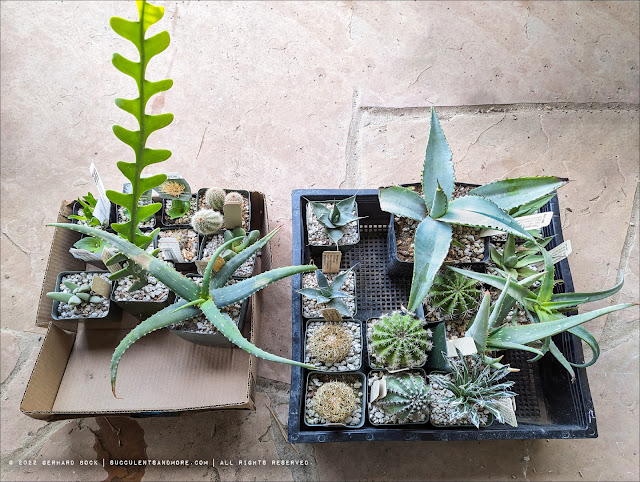
On November 6, I attended my first plant sale at the Huntington . My expectations were high: I had visions of table upon table of plants propagated from the garden’s extensive collections as well as a large selection of plants from the Huntington’s International Succulent Introductions (ISI) program. The reality was less extravagant. Yes, there were tables with succulents from the gardens and a (very) small selection of ISI plants, but the large majority of plants—virtually all the perennials, shrubs, etc.—were bought in from wholesale growers. From talking to volunteers and other attendees, it sounds like the spring sale (usually in April) is much larger, both in terms of square footage and inventory. I’ll make an effort next spring to check it out for myself. While the overall selection wasn’t what I had hoped, I still found a bunch of nice plants, both for myself and for several friends who had given me a wish list. Here’s my haul from the Huntington: In a surprise to exactly no o...

Desert Garden at The Huntington: New World

Image
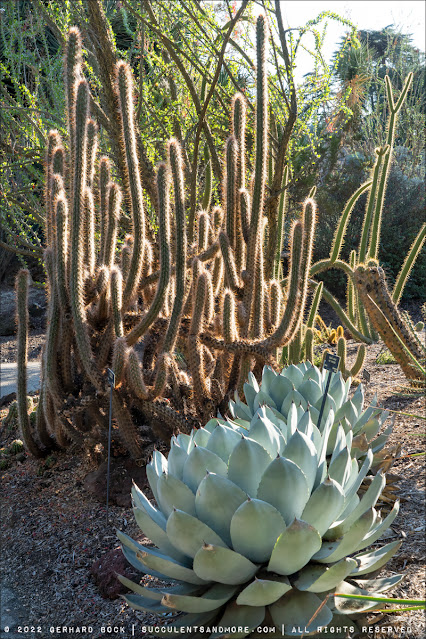
In my previous post I covered the Old World section of the Huntington Desert Garden. It’s located near the top of a rise, adjacent to the Desert Garden Conservatory . From here the land gently slopes downward towards the New World section. On a cold night, the temperature difference between the top of the rise and the bottom can be as much as five degrees (source: The Botanical Gardens at the Huntington , see below). This greatly benefits the aloes, planted higher up. The cacti and other New World succulents planted further down the slope are apparently better able to handle the colder temperatures—not that it ever gets truly cold in Pasadena (zone 10a). Teaser of what you’re going to see in this post

Desert Garden at The Huntington: Old World

Image
The Huntington in San Marino, CA is one of California’s great estates. Established by businessman Henry Huntington in the early 1900s on what was originally a 600-acre ranch, the Huntington comprises a world-class library , art collections and 120 acres of gardens . At the entrance to the Desert Garden: giant timber bamboo ( Bambusa sp.), tree aloe ( Aloidendron barberae ) and blue foxtail agave ( Agave attenuata ‘Boutin Blue’) The most famous of these is the 10-acre Desert Garden. It was started in 1907 when garden superintendent William Hertrich , a trained landscape gardener who had come to California from Germany in 1903, convinced Henry Huntington to plant cacti on a hillside that was very visible from the main drive but where little else would grow. As Hertrich recalls in his book The Huntington Botanical Gardens, 1905-1949: Personal Recollections of William Hertrich , “[Huntington] thoroughly disliked all types of cacti. His dislike was readily understandable … while bac...

Did you know you that the Huntington sells (and ships) succulents?

Image
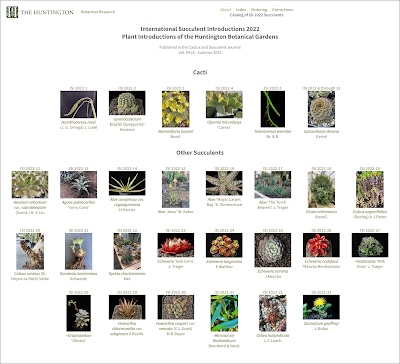
Except for periodic plant sales, the nursery at the Huntington is not open to the public. However, from their International Succulent Introductions (ISI) website, you can order plants at any time between March and September. In addition to the current 2022 offerings (28 of them!), you can browse the introductions for the past 20 years, dating back all the way to 2002. Many older plants may no longer be available, but it’s worth poking around. Unless a plant is labeled out of stock, you should be able to order it. 2022 International Succulent Introductions The program that would become ISI was started in 1958. Its objective is to “propagate and distribute new or rare succulents to collectors, nurseries and institutions.” The ISI sells seedlings, rooted cuttings and, increasingly, tissue-cultured plants. The cool thing is that many offerings are propagated from plants growing right at the Huntington; some are literally not available anywhere else. This is a unique opportunity to have...

Huntington Desert Garden: agaves, cacti and other New World succulents

Image
In my previous post I covered the Old World section of the Huntington Desert Garden. It’s located near the top of a rise, adjacent to the Desert Garden Conservatory . From here the land gently slopes downward towards the New World section. On a cold night, the temperature difference between the top of the rise and the bottom can be as much as five degrees (source: The Botanical Gardens at the Huntington , see below). This greatly benefits the aloes, many of which are quite tender. Clearly, the cacti and other New World succulents planted further down the slope are better able to handle the colder temperatures—not that it ever gets truly cold in Pasadena (zone 10a). While the plants in the Desert Garden are roughly separated by location (Old World, New World) and some beds are dedicated to regional flora (Sonoran and Chihuahuan Desert; California desert; Madagascar; etc.), there is some overlap. According to The Botanical Gardens at the Huntington (see below) the overarching principl...

Huntington Desert Garden: aloes and other Old World succulents

Image
On December 27, 2014 I finally had the opportunity to visit the Huntington in San Marino, CA , one of California’s great estates. Established by businessman Henry Huntington in the early 1900s on what was originally a 600-acre ranch, the Huntington comprises a world-class library , art collections and 120 acres of gardens . Foxtail agaves ( Agave attenuata ‘Boutin Blue’), some of them in flower. Behind it is a mature tree aloe ( Aloidendron barberae ). The most famous of these is the 10-acre Desert Garden. It was started in 1907 when garden superintendent William Hertrich convinced Henry Huntington to plant cacti in an area where little else would grow. Huntington initially agreed to let Hertrich experiment on ½ acre. Hertrich went ahead at full steam, filling the ½ acre lot with 300 cactus. In 1908, Hertrich hauled three carloads of saguaros from Arizona, followed in 1912 by two carloads of cacti and other succulents from Mexico. Huntington was finally convinced and gave Hert...

More magic: Huntington Desert Garden, fall, late afternoon

Image
This post continues my late-afternoon ramble through the Desert Garden at the Huntington in San Marino. Click here to read part 1. Here are some fun facts about the Desert Garden: Fun fact William Hertrich (1878-1966), the Huntington’s first superintendent of buildings and grounds, worked at the Huntington from 1904 to 1948 when he retired. In the Desert Garden’s early days, he went on a series of large-scale collecting trips. In 1908, he hauled three railway wagons of cacti from Arizona, including a wagon of saguaros. This was followed in 1912 by two wagons of cacti and other succulents from Mexico. The Huntington estate had its own spur line, making rail transport easy. [ * ] Borzicactus fossulatus and Agave parryi var. truncata Diamond cholla ( Cylindropuntia ramosissima ) Agave potatorum with emerging flower stalk The showiest Agave potatorum I’ve ever seen Just look at these spines and teeth... ...or should I say fangs! The bud imprints on the leaves are sweet, too Agave marmo...