Posts

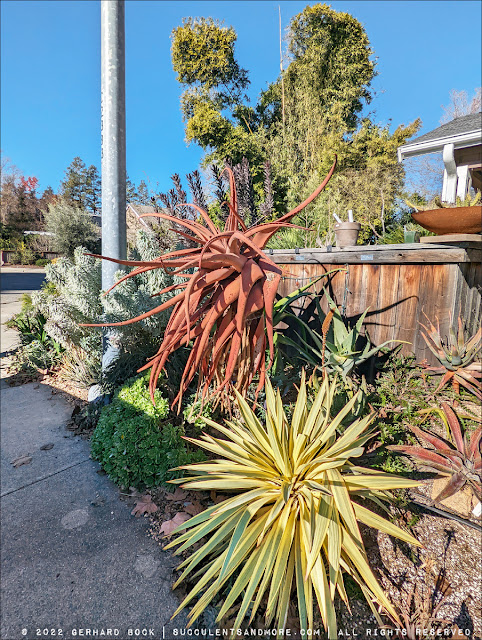
Aloe excelsa removed, diagnosed, treated, and convalescing
Image
Over the last year or so, I've periodically shown photos of our Aloe excelsa , located in the long L-shaped bed along the sidewalk. While it's common for this species to assume a reddish hue in the winter, it should revert to green in the summer, especially when watered. Ours has been stuck on red for a year and half now, prompting this recent comment by a reader:  “[Y]our excelsa is definitely having issues. It should green up in summer and only take on color in the cooler season. There’s healthy red on plump leaves and then there’s death throes red on a starved, declining plant. My guess is either this is a living crown on a dead stem (tree-type aloe stems seem to be more frost sensitive than the crown) or there aren’t much feeder roots and only anchoring roots. It just seems like it’s not taking up water at all. You might inspect around the crown in the dead leaves for aerial roots trying to make their way down to the soil. If you find them, that stem is indeed dead.” JM, th...

Misty January morning at UC Davis Arboretum

Image
The UC Davis Arboretum is a 100-acre treasure on the 5,300-acre University of California, Davis campus . Unlike botanical gardens with fences, gates, and fixed opening hours, the UC Davis Arboretum is accessible to the public around the clock. It's without doubt the most beloved place in town—on any given morning, you'll see people bicycling, running, walking their dogs, pushing strollers, bird-watching, you name it. Since the UC Davis campus is in the heart of town, the Arboretum is no more than 15 minutes away for most Davis residents. Kniphofia  'Christmas Cheer' in the Ruth Risdon Storer Valley-Wise Garden On Sunday morning, I took our dog for a walk at the  western edge of the Arboretum : the Shields Oak Grove, the Storer Valley-Wise Garden, the White Garden, and perimeter of the Teaching Nursery where in the BCE—the before-Covid era—the Arboretum plant sales were held. The area inside the magenta rectangle is what is covered in this post. Map © UC Davis. It was a...

Apology for blog outage

Image
As you may have noticed, Succulents and More was unavailable from Friday, January 14, until Monday, January 17. I'm truly sorry. This issue came as a complete surprise and was entirely out of my control. Some background: The domain for my blog, succulentsandmore.com, is registered through Blogger (i.e. Google) with Enom , one of the largest domain name registrars in the world. On Friday, Enom performed a scheduled migration to a new data center. It was supposed to last for 12 hours and have no effect on DNS resolution . I assume that's why I didn't receive any advance notice. Unfortunately, things did not go as planned. The outage, which was supposed to last for 12 hours, continued for 75 hours, and it made as many as two millions websites unreachable. This was not  supposed to happen in the first place, but apparently even large technology companies with hundreds of engineers are capable of FUBARing things—on a massive scale, too! Again, I apologize if you tried to visi...

People-friendly agaves

Image
Many gardeners like the beauty and grace of agaves but are afraid of them because of their often fierce armaments. It's true, many agave species have impressive (read: scary) teeth and spines. But there are plenty of others that are less likely to cause bodily harm when you get too close. Recently, I was asked which agaves are the most people-friendly. A dozen or so came to mind immediately, and a bit of research unearthed some others.  The meaning of “people-friendly” is open to interpretation, but for me, the major factor is the lack of rip-your-skin teeth along the leaf margins—they are the biggest cause of injury. Do bear in mind that many species with smooth leaves still have a terminal spine at the leaf tip, so maintain some degree of caution when handling. A good example is Agave victoriae-reginae : It has rigid but smooth leaves that terminate in a stiff spine. Below is a listing of agave species, hybrids, and cultivars with reasonably smooth leaves. The list is in two par...