Posts

Photo of the Day: Acacia baileyana starting to bloom

Image
Photo of the Day for Thursday, January 31, 2019 (yikes, the last day of January already!!!): Acacia baileyana 'Purpurea' Late winter is acacia time around here. Our Cootamundra wattle ( Acacia baileyana 'Purpurea') is now 20 ft. tall and covered with blossoms. This is one of the first branches with open flowers. I love the contrast between the bluish-silver leaves and the golden-yellow puffball flowers. This is the first time this acacia has flowered.

Agave hunter Ron Parker's personal collection

Image
I recently reviewed Chasing Centuries: The Search for Ancient Agave Cultivars Across the Desert Southwest , Ron Parker's groundbreaking book about agave species cultivated and refined by the pre-Columbian cultures of Arizona. It's a book unlike any other, and I highly recommend it if you have even a passing interesting in the prehistoric peoples of Arizona and, of course, agaves. On my after-Christmas Arizona trip , I had the opportunity to visit Ron on his home turf in Fountain Hills, northeast of Phoenix. To say that where he lives is pretty is like saying the Grand Canyon is alright. This is the view west from his street: And this is his front yard:

Photo of the Day: do as I say, not as I do

Image
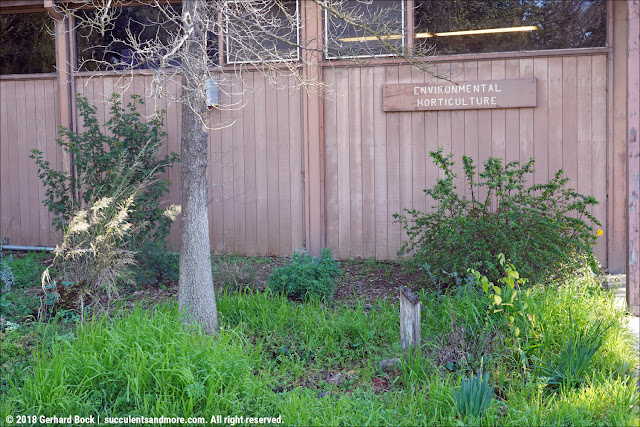
Photo of the Day for Monday, January 28, 2019 Seen yesterday on the University of California Davis campus: This is the Environmental Horticulture building. You'd think that they'd use this planting bed as showcase for their department! Unless the weeds aren't weeds at all but a new kind of plant breeding breakthrough?

Debris-collecting Agave macroacantha had to go

Image
Once upon a time, in March 2014 to be precise, I planted a beautiful Agave macroacantha outside the front yard fence, next to the 'Black Lace' elderberry and one of three  Aloe 'Moonglow'. When I say beautiful, this is what I mean: Agave macroacantha with backlit marginal teeth and terminal spines It looked like this right after planting: Agave macroacantha perfection right after planting in March 2014; look how small the Aloe 'Moonglow' was (on the left)

Photo of the Day: Hechtia fosteriana

Image
Photo of the Day for Friday, January 25, 2019: Hechtia fosteriana  (AS439) Hechtia fosteriana  is a terrestrial bromeliad native to Oaxaca, Mexico. Like many hechtias, it changes color throughout the year in response to cold, heat, and availability of water. My specimen came from Andy Siekkinen . I'm nuts about this color! © Gerhard Bock, 2019. All rights reserved. No part of the materials available through www.succulentsandmore.com may be copied, photocopied, reproduced, translated or reduced to any electronic medium or machine-readable form, in whole or in part, without prior written consent of Gerhard Bock. Any other reproduction in any form without the permission of Gerhard Bock is prohibited. All materials contained on this site are protected by  United States and international copyright law and may not be reproduced, distributed, transmitted, displayed, published or broadcast without the prior written permission of Gerhard Bock. If you are reading this...

Photo of the Day: Acacia merinthophora

Image
An ongoing project at work is taking up so much of my time that it's affecting the number of posts I'm able to write for Succulents and More. Right now, I seem to be managing no more than two a week.  That's not enough for me. To make up for it, I've decided to give myself a challenge that won't be a big time commitment: Starting right now, I'll post one new photo a day. It could be from our garden or from anywhere I happen to be that day. That'll allow me to share a small vignette of my life with you on a more regular basis. Here's the Photo of the Day for Thursday, January 24, 2019: Zig-zag wattle ( Acacia merinthophora ) With their lack of real leaves, acacias are an odd bunch to begin with. The zig-zag wattle ( Acacia merinthophora ) is even odder since it's taking the no-leaf business to an extreme. The long greenish things you might think are leaf stalks (petioles) with the actual leaves missing, are called phyllodes. That...

Aloes getting ready to flower in our garden

Image
We had a couple of nights a degree or two below freezing in December, but it's been warmer than usual since then. Not that I'm complaining; I'd happily never experience frost again, at least not where I live. If this weather keeps up, it won't be long now before the aloes in the front yard will be in full bloom. This Aloe wickensii (lumped by some in with Aloe cryptopoda ) has a head start on the others. It has never looked this good before: Aloe wickensii

Catching up with agave wizard Greg Starr in Tucson

Image
Over the years, I've become friends with Greg Starr , author of the Timber Press book  Agaves: Living Sculptures for Landscapes and Containers  and owner of Starr Nursery . I visit him and his wife Carol whenever I'm in Tucson, and this time was no exception. I always love hearing about his discoveries on agave expeditions to Mexico and seeing what he has growing in his greenhouses. And I never fail to find cool plants I simply must have. Greg lives on the west side of Tucson, pretty close to the edge of the city. The Tucson Mountains are just a few miles away; beyond them are the western unit of Saguaro National Park, the Arizona-Sonora Desert Museum, and the Old Tucson Studios theme park. The properties in this part of Tucson seamlessly merge into the desert. "Borrowed scenery"  is not just an abstract concept here, it's reality:

Electric Desert: after dark at the Desert Botanical Garden

Image
The Desert Botanical Garden (DBG) in Phoenix, AZ likes to light up the night. When I was there in December 2013, they had a large-scale exhibit of Dale Chihuly glass sculptures which attracted crowds both during the day and at night (a record-breaking 631,000 visitors). In December 2015 they hosted  Bruce Munro's Sonoran Light installatio n (318,000 visitors). This year, it was Electric Desert,  created by video artist Ricardo Rivero and Klip Collective. Electric Desert On each of these occasions I went in December, which allowed me to experience both the special exhibit and Las Noches de las Luminarias , a beloved holiday tradition at the DBG combining 8,000 luminaria bags (hand-lit every night by volunteers) and holiday entertainment in nine different spots throughout the garden.

Off the grid in the Arizona desert: Jan Emming's Destination:Forever Ranch

Image
A large parcel of land away from it all, surrounded by scenery so beautiful you want to cry, with no neighbors in sight and the freedom to do exactly what you want: Who hasn't dreamed of that at some point in their lives? I certainly have. But how many people actually turn this heady fantasy into reality? Precious few. However, there are some who do. Jan Emming is one of them. A Colorado native, he began in the late 1990s to scour the western U.S. for a site where he could create the desert garden he'd been envisioning since he was a teen. In 1998 he found what he was looking for: 40 acres in northwestern Arizona near the small town of Yucca. This is a very special spot where the Mojave meets the Sonoran Desert. I was astounded to find Joshua trees, the signature plant of the Mojave, growing side by side with saguaros, the signature plant of the Sonoran. Add ocotillos, chollas, hedgehog and barrel cactus, California junipers and scrub oak, and you have a great start for a d...