Posts

I had some hostas in Davis...

Image
“I had a farm in Africa at the foot of the Ngong Hills.”  One of my favorite movies, Out of Africa , begins with these haunting works, spoken by Meryl Streep's aging character Karen Blixen as she remembers her life in Kenya (then British East Africa). “The Equator runs across these highlands, a hundred miles to the north, and the farm lay at an altitude of over six thousand feet. In the day-time you felt that you had got high up; near to the sun, but the early mornings and evenings were limpid and restful, and the nights were cold.” This post is nowhere near as fascinating as Blixen's remembrance of a life and love lost long ago (a real story, not fiction), but my lament is similarly wistful. I had some hostas in Davis not far from Interstate 80. They grew happily in the backyard when I first planted them, but they struggled in the summer heat. Our winters were so mild, they weren't able to spend enough time in dormancy. As a result, they were smaller and weaker w...
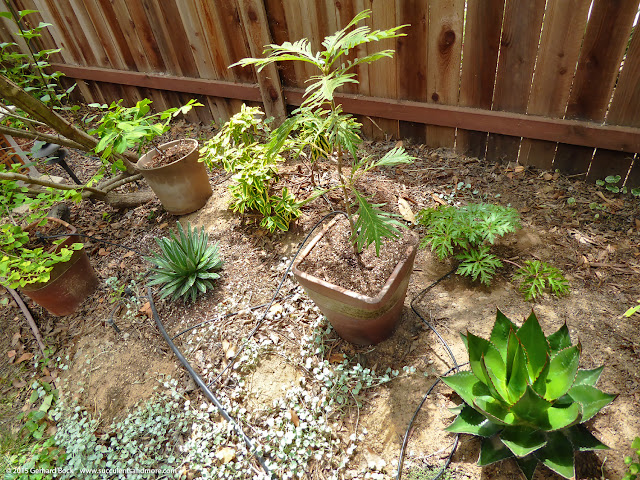
This is where the plants from Annie's Annuals went

Image
As May is drawing to a close and daytime temperatures are climbing into the upper 80s, the planting window is about to close for summer. As it is, putting new plants in the ground now is pushing things. But can you do when you have a tray of new acquisitions (a.k.a. the plants I bought at  Annie's Annuals & Perennials  last Saturday) to find a home for? Here is what I did with them: The purple-flowering  Geranium maderense  went in the backyard. This is the spot that used to be occupied by Borinda papyrifera , a bamboo I removed in June 2014.  The small potted tree is the cut leaf emperor oak ( Quercus dentata 'Pinnatifida') I brought back from Portland last summer. It has put on quite a bit of growth even though it's generally a slow grower. The agave on the right is Agave montana , the one on the left Agave victoria-reginae .

Return to the Wave Garden

Image
Last Saturday, after visiting Annie’s Annuals & Perennials in Richmond, I took my mother-in-law to see the Wave Garden in nearby  Point Richmond . I wrote a long post about this very special garden in February 2014. Please refer to it to see how it it has developed. As I said in my earlier post, the owners of the Wave Garden,  Jeanne and Vern Doellstedt , bought the property adjacent to their home to prevent it from being developed (and presumably from blocking their view of San Pablo Bay, the northern extension of San Francisco Bay). They decided to turn it into a collaborative space combining concrete walls and paths, metal gates and fences, and lush yet drought-tolerant plantings that provide visual interest and color year round. To top it all off, they elected to open the garden up to the public to enjoy. The result is utterly stunning and unique, as you will see in this post. This gate greets you at the lower entrance (there’s an upper entrance...

Memorial Day visit to Annie’s Annuals

Image
This weekend is Memorial Day weekend in the U.S., one of only a few 3-day weekends we have. Badly in need of a nursery fix, I decided to head to Annie’s Annuals in Richmond, CA on Saturday. My mother-in-law was my shopping companion. Davis was bright and sunny when we left, but Richmond (some 50 miles away) was gray and overcast when we arrived. I was thrilled since overcast skies make for better photography. I was surprised by the number of cars in Annie’s lot—we had to park quite a ways away. It turned out a huge crowd had shown up for a talk on gardening during the drought at 11 a.m. Normally I would have loved to hear what the speaker, garden designer Kate Frey , had to say but my mother-in-law and I decided to get our shopping done while the nursery was virtually empty. A 15% off sale on all plants was an extra incentive to load up the cart. I brought my wife’s compact point-and-shoot camera and took a lot of snaps as I wandered through the nursery. I’ve been to Annie’s quite ...

Our house on Google Earth

Image
While I post many photos of our garden, both in the front and back, it may be difficult for those of you who haven’t visited us to figure out exactly what the layout of our property is. Fortunately, Google Earth provides satellite imagery that is extremely useful for this purpose. All of the images below were captured with Google Earth Pro (download for free from here if you don’t have it yet). All rights to these images remain with Google and the various image providers. This image shows all of Davis, CA. The road bisecting the town is Interstate 80. Sacramento is 15 miles to the east (right), San Francisco 70 miles to the west (left). The red arrow indicates the approximate location of our house. Moving in closer, you can see that we’re very close to the edge of town. The fields in the foreground are outside the city limits and in another county.

May 2015 snapshot of the front yard

Image
May has been a great month this year, lack of rain notwithstanding. With daytime highs almost 10 degrees below average, i.e. low 70s instead of low 80s, I felt like I was in San Diego County instead of the greater Sacramento area. Invariably the weather will heat up and summer will descend upon us, stressing both humans and plants. For now, though, the floral display in the front yard continues. Time to take a stroll! Penstemon ‘Firebird’ (complex hybrid involving Penstemon cobaea , P. hartwegii , P. campanulata , P. gentianoides and P. isophyllus ) Parkinsonia ‘Desert Museum’

My agave cactus is blooming for the first time

Image
Friends who aren’t into spiky plants are eternally confused as to what the difference is between cacti and succulents. This is what I tell them: All cacti are succulents, but not all succulents are cacti. For example, agaves are succulents but not cacti. So far so good. But what about the agave cactus? Yes, there is such a thing. It looks a lot like an agave, but it’s a real cactus. Mine is blooming for the first time, and the flowers are a dead giveaway. The botanical name of the agave cactus is Leuchtenbergia principis . It’s the only species in the genus Leuchtenbergia , which underscores what a special plant it is. It’s related to the genus Ferocactus , home to many iconic barrel cacti. Supposedly it can hybridize with them, although I’ve never seen such an intergeneric cross.

Sue’s impressive front yard makeover

Image
Fellow Davis gardener Sue Fitz is no stranger to this blog. I’ve featured her expansive backyard a few years ago and I’ve written about her volunteer work at Woodland High School . Now it’s time to take a look at her recent front yard makeover. A year ago the Fitz’s front yard looked like this: With a lawn sloping down to the sidewalk and foundation shrubs against the house, it was the kind of old-school front yard all of us are used to seeing. But no more. This is what the Fitz front yard looks like now:

The elephant in the room, a.k.a. our front lawn

Image
As the drought in California and other parts of the western U.S. continues unabated, more and more homeowners are switching to water-wise landscaping. In our garden, we’ve been focusing on low-H₂O plants since the beginning so we haven’t had to swap out large swaths of plant material to accommodate the new normal. All planting strips and beds are on drip irrigation, which runs once a week for 20 minutes. However, there’s a metaphorical elephant that stares you right in the face when you look at the following photos: the front lawn. At roughly 400 sq.ft. it isn’t huge and in previous years it was used regularly by our kids, but as yet another bone-dry summer approaches, it’s getting harder and harder to justify its existence. It, too, gets watered once a week for 20 minutes and is doing reasonably well on this new regimen. Yet I bet the lawn sprinklers running at full blast for 20 minutes put out much more water than a drip system would.

Flowering agave update (May 2015)

Image
Time for an update on the Agave desmettiana ‘Variegata’ next to the front door. I first noticed at the beginning of September 2014 that it was getting ready to flower. By mid-October the flower stalk was already 8 ft. tall. In February 2015 the first flowers opened up. Now, in May 2015, most flowers are gone and the plant’s decline is accelerating. (This agave, like most, is monocarpic, meaning it dies after flowering.) Eventually the dead carcass will have to be removed. My plan is to leave it until fall and tackle this task when the weather starts to cool down.